Data Room for Due Diligence: Complete Checklist, Structure & Setup Guide for Startups and SMEs
Why Most Deals Slow Down at the Due Diligence Stage
In most fundraising or acquisition conversations, momentum builds quickly in the beginning.
The pitch is clear. The opportunity looks attractive. Initial discussions are positive.
Then the process enters a more rigorous phase.
Investors ask for access to detailed business information. Financials need to be validated. Legal structures are reviewed. Contracts are examined. Assumptions are tested.
This is where deals often slow down.
Not because the business is weak, but because information is incomplete, scattered, or difficult to interpret.
The Hidden Friction That Slows Deals
Instead of progressing toward closure, the process shifts into repeated back-and-forth:
- “Can you share this document?”
- “This version seems outdated”
- “We need clarification on this contract”
- “Where is the latest cap table?”
Each of these requests introduces friction.
Over time, that friction compounds into delays in decision-making, increased scrutiny, and reduced investor confidence.
In some cases, it leads to renegotiation. In others, the deal quietly loses momentum.
What Actually Separates Fast vs Delayed Deals
What separates smooth transactions from delayed ones is rarely just financial performance.
It is how well the company presents and organizes its information.
This is where a structured data room becomes critical.
A well-prepared data room allows investors to move through the evaluation process without unnecessary interruptions. It reduces uncertainty, improves clarity, and creates a more predictable path toward closing.
Table of Contents
What is a Data Room in Due Diligence?
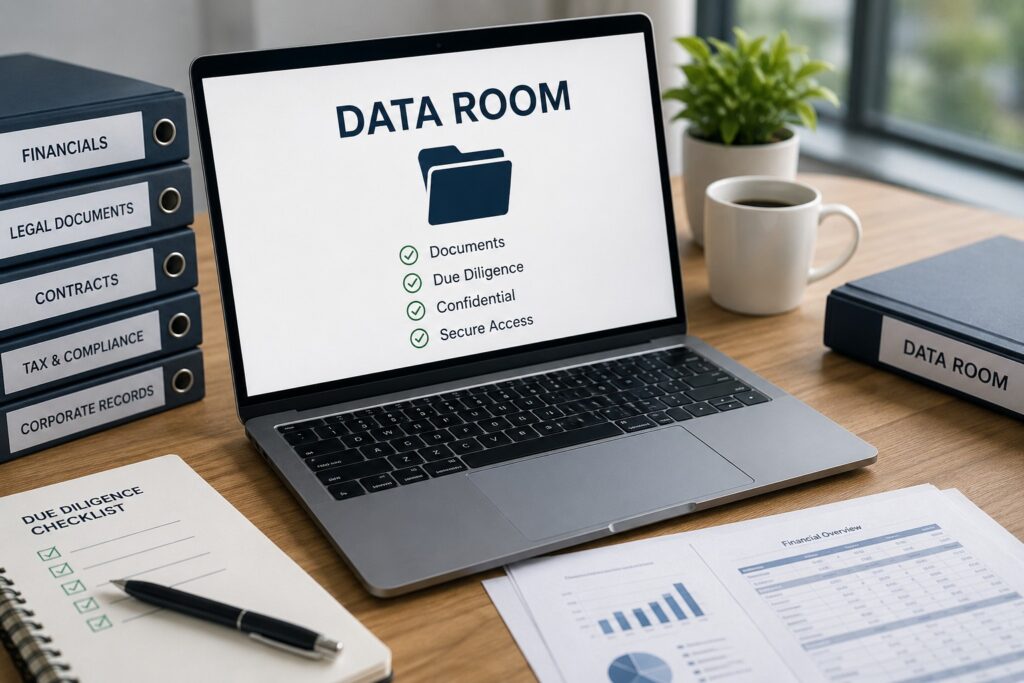
A data room, in the context of Due Diligence, is a centralized and structured repository of information that allows external stakeholders to evaluate a business.
This typically includes investors, acquirers, lenders, or strategic partners.
At a basic level, many companies assume a data room is simply a shared folder containing documents.
That interpretation is incomplete.
Data Room vs Simple File Storage
A functional data room is not defined by where documents are stored, but by how information is organized, presented, and validated.
There is a meaningful difference between uploading documents to a cloud drive and building a transaction-ready data room.
A generic file folder:
- Lacks structure
- Contains mixed versions
- Requires manual explanation
A well-prepared data room:
- Follows a logical hierarchy
- Contains verified and current documents
- Anticipates investor questions
- Enables independent review
This distinction becomes important during due diligence, where investors are not just collecting documents, but forming judgments about financial reliability, legal clarity, and operational discipline.
Why Data Rooms Exist in Transactions
The purpose of a data room is to reduce information asymmetry.
In any transaction, one party has significantly more knowledge about the business than the other. Due diligence exists to bridge that gap.
The data room acts as the interface through which this happens.
It allows investors to:
- Verify financial performance
- Understand legal obligations
- Identify potential risks
- Assess scalability and governance
A well-structured data room does not just provide answers. It reduces the number of questions that need to be asked.
Physical vs Virtual Data Rooms
Historically, data rooms were physical spaces where documents were stored and reviewed in person.
Today, most transactions use virtual data rooms:
- Secure cloud-based platforms
- Controlled access permissions
- Activity tracking
- Version management
However, the platform itself is not the deciding factor.
A poorly structured virtual data room creates the same problems as a poorly organized folder.
A well-structured basic drive can often be more effective than an expensive but disorganized system.
Key Takeaway
A data room is not a document dump.
It is a structured system designed to support due diligence, reduce friction, and enable informed decision-making.
Where the Data Room Fits in the Deal Lifecycle
A data room is not created in isolation. It sits within a broader transaction flow and directly influences how smoothly that flow progresses.
Understanding where it fits helps clarify why it matters.
Stage 1: Pre–Due Diligence Preparation
This is where the data room should ideally be built.
At this stage:
- The company prepares documents
- Financials are cleaned and updated
- Legal and compliance gaps are identified
- Folder structures are created
Most founders underestimate this stage and start building the data room only after investor interest is confirmed.
That is usually a mistake.
When preparation is delayed, the process becomes reactive. Documents are uploaded in a rush, inconsistencies creep in, and early investor confidence weakens.
A well-prepared data room before formal due diligence begins creates a strong first impression and reduces early friction.
Stage 2: Due Diligence Review
This is where the data room is actively used within the process of Due Diligence.
Investors and their advisors begin reviewing the contents systematically.
Typical activities at this stage include:
- Financial validation
- Legal review of contracts and structure
- Tax and compliance checks
- Operational and commercial analysis
The quality of the data room directly impacts:
- Speed of review
- Depth of questioning
- Overall confidence in the business
A structured and complete data room allows investors to move forward with fewer interruptions.
A weak data room leads to repeated queries, longer timelines, and deeper scrutiny.
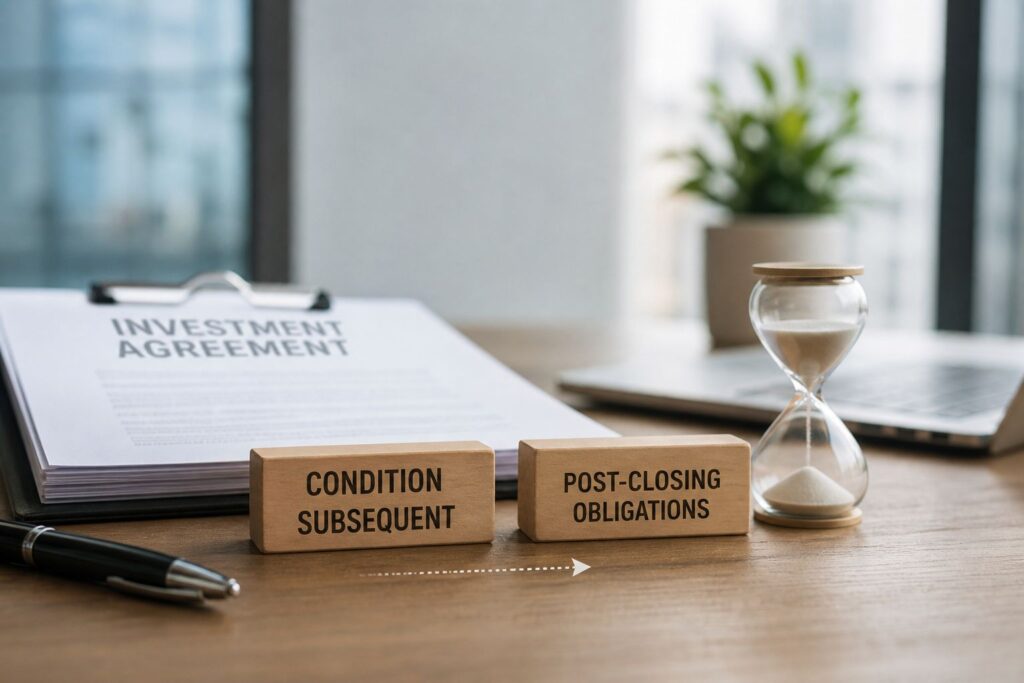
Stage 3: Closing and Post-Closing
Insights from the data room and due diligence process feed directly into deal execution.
This typically leads to:
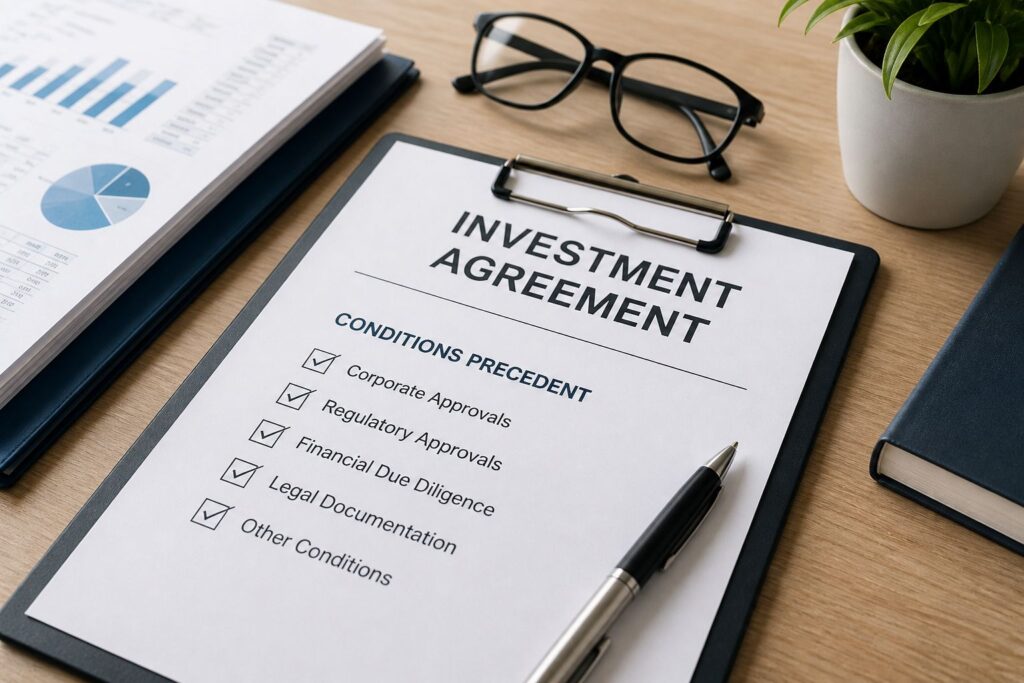
- Conditions that must be satisfied before closing
- Obligations that continue after closing
While these are formalized later in transaction documents, they are often triggered by gaps or risks identified during data room review.
In that sense, the data room does not just support due diligence. It shapes how the deal is structured.
Key Takeaway
The data room is not a passive repository.
It is an active component of the deal lifecycle that influences preparation, evaluation, and execution.
What Investors Actually Look for in a Data Room
Founders often assume that investors go through every document in detail.
In reality, that is not how most reviews happen.
Experienced investors and advisors approach a data room with a different objective. They are not just collecting information. They are forming a judgment.
Investors Are Looking for Patterns, Not Just Documents
A single document rarely tells the full story.
Investors look for consistency across multiple sources:
- Do financials align with reported metrics?
- Do contracts reflect claimed revenue streams?
- Does the cap table match prior disclosures?
Any inconsistency, even if minor, can trigger deeper investigation.
Clarity Signals Operational Discipline
A well-structured data room sends a strong signal.
It suggests that:
- The company maintains proper records
- Financial reporting is reliable
- Legal and compliance matters are under control
This builds confidence before detailed discussions even begin.
On the other hand, disorganized or incomplete data creates doubt.
Not necessarily about intent, but about control.
Risk Identification Is the Core Objective
At its core, due diligence is about identifying risk.
Investors use the data room to uncover:
- Legal exposures
- Financial inconsistencies
- Compliance gaps
- Dependency risks (key clients, vendors, employees)
The goal is not to find a perfect business. It is to understand where risks exist and how they can be managed.
Speed of Access Influences Deal Momentum
Time is a critical factor in transactions.
If investors can quickly locate and verify information:
- The process moves faster
- Fewer follow-up requests are needed
- Internal approvals happen more smoothly
If access is slow or unclear:
- Momentum drops
- Internal teams lose alignment
- The deal timeline extends
In competitive scenarios, this can directly affect outcomes.
What Creates Red Flags
Certain patterns immediately raise concerns:
- Missing or incomplete documents
- Outdated financial information
- Multiple versions of the same file with no clarity
- Inconsistencies between documents
- Overly complex or unclear structures
These do not always indicate serious problems, but they increase perceived risk.
And in transactions, perceived risk often matters as much as actual risk.
Key Takeaway
Investors do not evaluate a data room based on volume.
They evaluate it based on:
- Consistency
- Clarity
- Completeness
- Ease of navigation
A strong data room reduces uncertainty.
A weak one amplifies it.
Complete Data Room Checklist for Due Diligence
This is the most critical part of your data room.
A well-structured checklist does two things:
- Ensures completeness
- Reduces back-and-forth during due diligence
Most delays happen not because documents don’t exist, but because they are missing, outdated, or hard to locate.
Below is a practical, investor-aligned checklist used in real transactions.
Corporate and Legal Documents
This section establishes the legal foundation of the company.
Investors use it to verify ownership, structure, and governance.
Include:
- Certificate of Incorporation
- Memorandum and Articles of Association
- Shareholders’ Agreement (if applicable)
- Updated Cap Table (fully diluted)
- Board resolutions and shareholder resolutions
- Details of subsidiaries or group entities
- Register of directors and shareholders
If there have been past funding rounds, ensure:
- All allotment documents are included
- Share issuances match the cap table
Any mismatch here immediately raises concerns.
Financial Information
This is one of the most heavily reviewed sections.
Investors are not just looking at numbers. They are assessing consistency, reliability, and financial discipline.
Include:
- Profit and Loss statements (historical)
- Balance sheets
- Cash flow statements
- Audit reports (if available)
- Management accounts (recent months)
- Financial projections and assumptions
- Budget vs actual comparisons
Important:
- Ensure numbers match across all documents
- Avoid multiple conflicting versions
- Clearly label draft vs final
Even small inconsistencies can lead to deeper scrutiny.
Tax and Compliance
This section helps investors evaluate regulatory risk.
Include:
- Income tax returns
- GST filings
- TDS filings
- Statutory compliance records
- Notices, disputes, or ongoing proceedings
If there are any issues:
- Do not hide them
- Provide context and current status
Transparency here builds more trust than perfection.
Contracts and Liabilities
This section gives insight into how the business operates commercially.
Investors use it to understand dependencies and obligations.
Include:
- Key customer agreements
- Vendor and supplier contracts
- Partnership agreements
- Lease agreements
- Loan agreements and credit facilities
- Any guarantees or contingent liabilities
Focus on:
- Revenue-linked contracts
- Long-term obligations
- Termination clauses
If a large portion of revenue depends on a few contracts, that will be closely evaluated.
HR and Employment
This section helps assess team stability and potential liabilities.
Include:
- Employee list with roles and compensation
- Employment agreements
- Offer letters
- ESOP or equity incentive plans
- Founder agreements
For key personnel:
- Ensure contracts are properly executed
- Include non-compete or confidentiality clauses if applicable
Unclear employment structures can become a risk factor.
Intellectual Property
This is especially important for technology and product-driven businesses.
Include:
- Trademark registrations
- Patent filings (if any)
- Copyrights
- Licensing agreements
- Documentation of IP ownership
- Assignment agreements from founders or developers
One critical point:
If IP is not formally assigned to the company, it can become a major deal issue.
Operational and Business Metrics
This section provides insight into how the business actually performs.
Include:
- Key performance indicators (KPIs)
- Customer acquisition data
- Retention and churn metrics
- Sales pipeline
- Unit economics
- Product documentation or tech architecture (if relevant)
This is where narrative meets data.
Your metrics should support the story presented in your pitch.
Miscellaneous but Important
Some items do not fit neatly into categories but are still important.
Include:
- Insurance policies
- Litigation details (if any)
- Regulatory licenses
- Environmental or industry-specific approvals
How to Use This Checklist Effectively
A checklist alone is not enough.
Execution matters.
- Ensure all documents are current
- Use consistent naming conventions
- Avoid duplicates unless clearly labeled
- Organize documents exactly as per folder structure
Think of the checklist as a minimum standard, not a maximum.
Key Takeaway
A complete data room is not about volume.
It is about:
- Relevance
- Accuracy
- Structure
- Consistency
When done right, this section alone can significantly reduce due diligence timelines.
Ideal Data Room Structure for Due Diligence
A complete set of documents is only useful if it is structured properly.
Investors should be able to navigate your data room without guidance. If they need constant clarification, the structure is already failing.
A clear, predictable folder hierarchy reduces friction and allows faster review.
Recommended Folder Structure
At the top level, keep it simple and logical:
- Corporate and Legal
- Financial Information
- Tax and Compliance
- Contracts and Agreements
- HR and Employment
- Intellectual Property
- Operations and Metrics
- Miscellaneous
Each of these should then be broken down into subfolders.
For example:
- Corporate and Legal
- Incorporation Documents
- Shareholding and Cap Table
- Board and Shareholder Resolutions
- Group Structure
- Financial Information
- Historical Financials
- Management Accounts
- Audit Reports
- Projections and Budgets
- Contracts and Agreements
- Customers
- Vendors
- Loans and Financing
- Leases
This level of structure allows investors to quickly locate information without scanning through unrelated files.
Naming Conventions That Actually Matter
Poor file naming is one of the most common and underestimated issues.
Avoid names like:
- Final_v2_latest_new.xlsx
- Scan_001.pdf
Instead, use clear and consistent naming:
- FY23_Audited_Financials.pdf
- CapTable_FullyDiluted_Mar2026.xlsx
- CustomerContract_ABC Pvt Ltd_Executed.pdf
Every file name should answer three things:
- What the document is
- Which period it relates to
- Whether it is final or draft
This reduces confusion and avoids unnecessary follow-up questions.
Version Control and Document Hygiene
Multiple versions of the same document create doubt.
To avoid this:
- Keep only the latest version in the main folder
- Move older versions into an “Archive” subfolder if required
- Clearly label drafts
Also ensure:
- No duplicate files across folders
- No broken or empty folders
- No irrelevant documents
A clean data room signals discipline.
Access and Permission Control
Not all documents need to be shared at the same stage.
Consider:
- Tiered access for sensitive documents
- Restricting edit permissions
- Tracking who has viewed what
Even if you are using a simple cloud drive, basic access control should be implemented.
Key Takeaway
A well-structured data room allows investors to focus on evaluation instead of navigation.
Clarity in structure often translates into confidence in execution.
Common Data Room Mistakes That Delay or Kill Deals
Most data room issues are not complex. They are basic mistakes repeated across transactions.
The problem is not the presence of these mistakes, but their impact on perception.
Treating the Data Room as a Last-Minute Task
Many companies begin organizing documents only after investor interest becomes serious.
This leads to:
- Rushed uploads
- Missing documents
- Inconsistent data
The data room should be prepared before formal due diligence begins, not during it.
Incomplete or Missing Information
Missing documents immediately raise questions.
Investors begin to wonder:
- Does the document not exist?
- Is there something being withheld?
Even if the reason is harmless, the perception is negative.
Inconsistent Financial Data
If financials do not match across documents, it creates doubt about reliability.
Examples:
- Revenue numbers differ between reports
- Cap table does not match share allotments
- Projections do not align with historical trends
These inconsistencies often lead to deeper investigation and slower progress.
Overloading Without Structuring
Uploading large volumes of data without structure does not help.
It creates noise instead of clarity.
Investors prefer:
- Relevant documents
- Clearly categorized
- Easy to navigate
More data is useful only when it is organized.
Poor File Naming and Version Confusion
Multiple versions with unclear labels lead to unnecessary confusion.
Investors should not have to guess:
- Which file is the latest
- Which version is accurate
This is a simple issue that has a disproportionate impact on perception.
Ignoring Legal and Compliance Gaps
Some founders assume that gaps will not be noticed.
In reality, due diligence is designed to uncover exactly those gaps.
Common issues include:
- Missing contracts
- Unclear IP ownership
- Pending compliance filings
It is better to disclose and explain than to leave gaps unaddressed.
Lack of Ownership and Coordination
In many companies, no single person owns the data room.
As a result:
- Documents are uploaded inconsistently
- Responses are delayed
- Accountability is unclear
Assigning clear ownership improves both speed and quality.
Key Takeaway
Most deal delays are not caused by complex issues.
They are caused by avoidable mistakes in documentation, structure, and communication.
Fixing these early significantly improves deal efficiency.
DIY vs Professional Data Room Setup
Not every business needs a fully managed data room from day one. But not every business should rely on a DIY approach either.
The right choice depends on the stage of the company, the size of the transaction, and the expectations of incoming investors.
When a DIY Data Room Works
A self-managed data room can be sufficient if:
- The business is at an early stage
- The number of documents is limited
- There are no complex legal or financial structures
- Fundraising is relatively small and informal
In these situations, a well-organized cloud drive with a clear structure and checklist can support basic due diligence requirements.
However, even in a DIY setup, discipline is essential. Structure, consistency, and completeness still determine how your business is evaluated.
Where DIY Starts Breaking Down
As the business grows, so does complexity.
A DIY data room often becomes difficult to manage when:
- Multiple funding rounds have taken place
- Cap tables become layered and harder to reconcile
- Contracts increase in volume and variation
- Compliance requirements expand
- Financial reporting becomes more detailed
At this stage, gaps begin to appear:
- Missing or outdated documents
- Inconsistent data across files
- Lack of alignment between legal and financial records
These issues may not be visible internally, but they become immediately apparent during due diligence.
What a Professional Data Room Setup Solves
A professionally prepared data room for due diligence focuses on more than document collection.
It ensures:
- Completeness aligned with transaction expectations
- Logical structuring based on how investors review information
- Cross-verification of financial and legal data
- Identification of gaps before they become deal risks
It also prepares the business to respond efficiently to due diligence queries, reducing friction throughout the process.
The Real Difference
The difference between DIY and professional setup is not just quality.
It is risk reduction and time efficiency.
A structured, investor-ready data room:
- Reduces back-and-forth communication
- Speeds up due diligence timelines
- Improves investor confidence
- Minimizes last-minute surprises
Key Takeaway
A DIY data room can work in simple situations.
For serious fundraising or transactions, a professionally structured data room becomes a strategic advantage rather than an operational task.
This is designed to help you build an investor-ready data room before entering formal due diligence.
How Ocellus Supports Data Room Preparation and Due Diligence
Preparing a data room is not just about organizing files. It is about aligning your business information with how investors evaluate risk, performance, and governance.
Ocellus supports this process as part of its transaction advisory and due diligence services.
Data Room Preparation
- Structuring folders based on investor expectations
- Identifying missing or incomplete documentation
- Standardizing formats and naming conventions
- Preparing investor-ready documentation
Due Diligence Readiness
- Reviewing financial and legal consistency
- Highlighting potential risks and gaps
- Supporting management in handling investor queries
- Ensuring alignment between internal data and external disclosures
Transaction Support
- Coordinating with legal and financial stakeholders
- Supporting fundraising and investment processes
- Assisting through closing and post-closing stages
This ensures that your data room is not only complete, but also aligned with how it will be evaluated during due diligence.
A Data Room is a Deal Execution Tool
A data room is often treated as a documentation requirement.
In reality, it is a critical component of deal execution.
It directly influences:
- The speed of due diligence
- The level of investor confidence
- The efficiency of issue resolution
A structured data room reduces uncertainty and allows investors to focus on evaluating the business rather than searching for information.
This creates a smoother path from initial discussions to deal closure.
Final Thought
Preparing a data room should not begin when investors ask for it.
It should begin when you start preparing for growth, fundraising, or any strategic transaction.
Prepare Your Data Room Before Investors Ask
If you are planning for fundraising, investment, or due diligence, preparing your data room early can significantly improve outcomes.
Ocellus can help you structure, review, and align your data room so that you are fully prepared before the process begins.
A well-prepared data room does not just support a deal. It helps move it forward.