
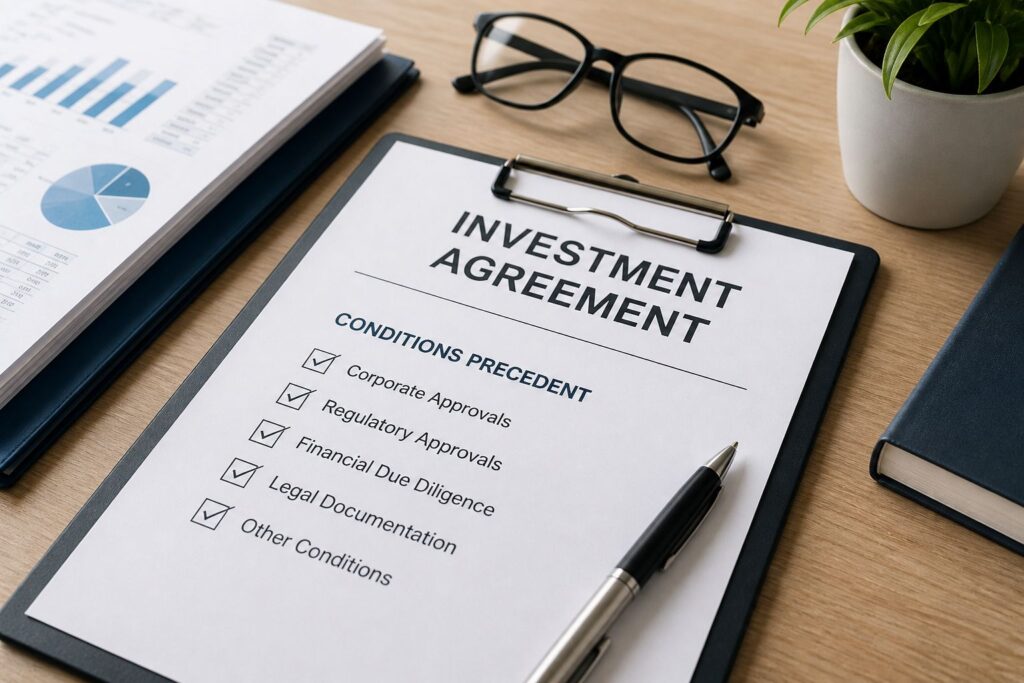
Condition Precedent in Investment Agreements: Checklist, Examples & How to Avoid Deal Delays
Why Deals Get Delayed at the Last Stage
By the time a funding deal reaches its final stage, most of the hard work appears to be done.
Valuation is agreed. Terms are negotiated. Legal documents are largely in place. Both sides are aligned in principle.
From the outside, it looks like the deal is about to close.
And yet, this is where many transactions slow down.
Investors hold back funds. Legal teams raise final requirements. Founders are asked to complete a set of conditions before the transaction can be executed.
What follows is often unexpected:
- “We need updated filings before closing”
- “This approval is still pending”
- “The cap table needs to be corrected”
- “Certain agreements must be executed first”
At this stage, momentum becomes fragile.
Delays of a few days can turn into weeks. Internal approvals expire. Investor priorities shift. In some cases, the deal begins to lose urgency.
Not because the business is weak, but because final conditions have not been met.
These conditions are known as Condition Precedent.
They are not formalities. They are the final gatekeepers before capital is deployed.
Understanding them early can be the difference between a smooth closing and a delayed or renegotiated deal.
Table of Contents
What is a Condition Precedent (CP) in an Investment Agreement?
A Condition Precedent, often referred to as “CP”, is a specific requirement that must be fulfilled before a transaction becomes legally effective or funds are transferred.
In the context of Corporate Law and investment agreements, CPs define what needs to be completed before the deal is formally closed.
Instead of treating a signed agreement as the end of the process, CPs recognize that certain risks, gaps, or formalities still need to be addressed.
Only after these are satisfied does the transaction move forward.
A Practical Way to Understand CPs
Think of a funding deal in two parts:
- Agreement is signed
- Conditions are fulfilled
- Funds are released
The signing of documents does not automatically trigger the transfer of money.
Between signing and fund transfer lies a controlled phase where all critical conditions must be met.
That phase is governed by Condition Precedent.
Why CPs Exist
CPs are designed to protect investors from unresolved risks.
During due diligence, investors often identify:
- Missing documentation
- Compliance gaps
- Structural inconsistencies
- Unresolved obligations
Some of these issues are critical enough that the investor will not proceed until they are resolved.
Instead of canceling the deal, they include these as CPs.
This allows:
- The deal to move forward in principle
- Risks to be addressed before execution
Not All CPs Are Equal
Some CPs are straightforward:
- Signing specific documents
- Providing updated reports
Others are more complex:
- Restructuring shareholding
- Completing regulatory filings
- Resolving contractual inconsistencies
The complexity of CPs directly affects:
- Deal timelines
- Coordination effort
- Risk perception
Key Takeaway
A Condition Precedent is not a legal technicality.
It is a control mechanism that ensures the business is fully prepared for investment before capital is deployed.
Treating CPs casually often leads to delays.
Managing them proactively is what enables smooth deal closure.
Where Condition Precedent Fits in the Deal Lifecycle
To understand Condition Precedent properly, it helps to place it within the full transaction flow.
A typical investment process moves through three broad stages:
- Preparation and information sharing
- Review and negotiation
- Execution and closing
Condition Precedent sits at the transition between negotiation and closing.
Stage 1: Preparation and Due Diligence
This begins with document sharing, often through a structured data room, followed by detailed review as part of Due Diligence.
At this stage, investors and their advisors:
- Validate financial performance
- Review legal structure and contracts
- Assess compliance and regulatory position
- Identify operational and governance risks
The outcome of this stage is not just a decision to invest.
It is also a list of issues that need to be resolved.
Stage 2: Negotiation and Documentation
Once both sides are aligned, the investment agreement is drafted.
This includes:
- Commercial terms
- Governance rights
- Investor protections
Alongside these, a set of Condition Precedent clauses is included.
These clauses translate due diligence findings into actionable requirements.
For example:
- If filings are pending → CP to complete filings
- If cap table is unclear → CP to correct ownership structure
- If contracts are missing → CP to execute agreements
This is where CP becomes structured and legally binding.
Stage 3: Pre-Closing Execution
After signing the agreement, the focus shifts to fulfilling CPs.
This is the most execution-heavy phase.
It typically involves:
- Coordinating with legal advisors
- Updating documentation
- Completing regulatory filings
- Aligning internal stakeholders
Only after all CPs are satisfied does the deal move to closing.
Stage 4: Closing
Once CPs are fulfilled:
- Investors release funds
- Shares are issued or transferred
- The transaction is formally completed
Without CP completion, closing does not happen.
Key Takeaway
Condition Precedent is the bridge between agreement and execution.
It converts due diligence findings into required actions and ensures that all critical issues are resolved before capital moves.
Why Condition Precedent Matters More Than Founders Realize
Many founders treat CPs as a checklist to complete after signing.
In reality, CPs have a much deeper impact on the outcome of the deal.
CPs Control Whether the Deal Actually Closes
A signed agreement creates intent.
Condition Precedent determines execution.
If CPs are not fulfilled:
- Funds are not transferred
- Shares are not issued
- The deal remains incomplete
This makes CPs one of the most critical components of the entire transaction.
CPs Directly Impact Deal Timelines
Every CP introduces a dependency.
Some can be completed quickly. Others require:
- External approvals
- Regulatory processes
- Multi-party coordination
If CPs are not planned and tracked properly, timelines expand.
This can lead to:
- Delays in fund availability
- Misalignment with business plans
- Increased pressure on founders
CPs Influence Investor Confidence
Investors closely observe how CPs are handled.
Delays, inconsistencies, or lack of clarity can signal:
- Weak internal processes
- Poor coordination
- Hidden risks
Even if the underlying issue is minor, the way it is handled affects perception.
On the other hand, structured and timely completion builds confidence and strengthens the relationship.
CPs Can Affect Deal Terms
In some cases, unresolved CPs can lead to renegotiation.
For example:
- Delays in compliance may raise concerns about regulatory risk
- Unresolved financial discrepancies may impact valuation
- Structural issues may lead to revised terms
This means CPs do not just affect timing. They can affect economics.
CPs Require Cross-Functional Coordination
Fulfilling CPs is rarely a single-team effort.
It involves:
- Legal teams
- Finance teams
- Founders and management
- External advisors
Without clear ownership and coordination, execution becomes fragmented.
Key Takeaway
Condition Precedent is not a post-agreement formality.
It is a critical execution phase that determines whether, when, and how a deal closes.
Founders who manage CPs proactively move faster and reduce risk.
Those who treat them casually often face delays, complications, or avoidable friction.
Common Condition Precedent Examples in Investment Deals
Condition Precedents are not generic. They are tailored to each transaction based on what is uncovered during due diligence.
However, in most startup and SME deals, CPs tend to fall into a few predictable categories. Understanding these in advance helps founders prepare before they become bottlenecks.
Corporate and Legal Condition Precedents
These ensure that the transaction is properly authorized and legally valid.
Common examples include:
- Board approval for the investment
- Shareholder approval for issuance or transfer of shares
- Amendments to the Articles of Association
- Execution of definitive agreements (SHA, SSA, etc.)
- Updating statutory registers
These are typically mandatory. Without them, the transaction cannot proceed legally.
Even when they seem procedural, delays often occur due to:
- Coordination between stakeholders
- Incorrect documentation
- Missed formalities
Financial Condition Precedents
These focus on ensuring that the financial position of the company is clear and reliable before funds are deployed.
Common examples include:
- Submission of updated financial statements
- Completion of audits or limited reviews
- Reconciliation of key financial data
- Clearance or restructuring of existing debt
- Confirmation of working capital position
If financial inconsistencies are identified during due diligence, they are often converted into CPs.
These can take time, especially if:
- Books are not up to date
- External auditors are involved
- Historical corrections are required
Compliance and Regulatory Condition Precedents
These address regulatory requirements that must be fulfilled before closing.
Common examples include:
- Filing of pending statutory returns
- Obtaining regulatory approvals (if required)
- Updating licenses or registrations
- Resolving notices or compliance gaps
These CPs can be particularly time-sensitive.
Delays often occur due to:
- Government processing timelines
- Incomplete documentation
- Lack of clarity on requirements
Ignoring these early can significantly extend deal timelines.
Structural Condition Precedents
These relate to the internal structure of the company, especially ownership and governance.
Common examples include:
- Cleaning up the cap table
- Converting informal arrangements into formal equity
- Creating or restructuring ESOP pools
- Removing inactive or legacy shareholders
- Aligning share classes and rights
Structural issues are common in growing startups and are often identified during due diligence.
These CPs tend to be complex because they require:
- Multiple approvals
- Legal restructuring
- Careful documentation
Contractual Condition Precedents
These ensure that key business relationships are properly documented and enforceable.
Common examples include:
- Execution of missing customer or vendor contracts
- Standardization of key agreements
- Assignment or novation of contracts
- Removal of unfavorable clauses
If revenue depends heavily on a few contracts, investors will pay close attention here.
Weak or undocumented agreements often become CPs.
Key Takeaway
Condition Precedents are not random requirements.
They are a structured response to risks identified during due diligence.
The more prepared your documentation and structure are in advance, the fewer CPs you will face at closing.
Condition Precedent Checklist for Founders
This is where most founders underestimate the process.
CPs are not just about completing tasks. They are about ensuring readiness across legal, financial, and operational dimensions.
Use this checklist before entering or during the closing phase of a deal.
Corporate and Legal Readiness
- Are all board and shareholder approvals planned and documented?
- Are Articles of Association aligned with the investment terms?
- Are all key agreements drafted and ready for execution?
- Are statutory registers updated and consistent?
Financial Readiness
- Are financial statements updated to the latest period?
- Are there any inconsistencies across reports?
- Are audits or reviews completed where required?
- Is the debt position clearly documented and aligned?
Compliance Readiness
- Are all statutory filings up to date?
- Are there any pending notices or regulatory issues?
- Are all required licenses valid and current?
Structural Readiness
- Is the cap table accurate and fully reconciled?
- Are all shareholders properly documented?
- Are ESOP structures clearly defined and approved?
Contractual Readiness
- Are key customer and vendor agreements executed?
- Are there any informal or undocumented arrangements?
- Do contracts reflect actual commercial terms?
Execution Readiness
- Is there a clear owner for each CP?
- Are timelines defined and tracked?
- Is coordination happening between legal, finance, and management?
Key Takeaway
A strong CP checklist reduces uncertainty before closing.
It allows founders to:
- Anticipate investor requirements
- Avoid last-minute delays
- Move through the closing phase with clarity and control
Common Mistakes Founders Make with Condition Precedents
Most delays at the closing stage are not caused by complex legal issues. They are caused by avoidable execution mistakes.
Understanding these patterns helps prevent unnecessary friction.
Treating CPs as a Post-Signing Formality
Many founders assume that once the agreement is signed, the deal is essentially done.
This mindset leads to:
- Late preparation
- Reactive execution
- Missed dependencies
In reality, the period between signing and closing is often the most execution-intensive phase.
Underestimating Time and Effort
Some CPs appear simple on paper but require multiple steps in practice.
For example:
- A “simple” filing may require documentation, approvals, and follow-ups
- Cap table corrections may involve multiple stakeholders and legal documentation
When timelines are underestimated, delays compound quickly.
Lack of Clear Ownership
In many cases, no single person is responsible for tracking CPs.
As a result:
- Tasks fall between teams
- Communication becomes fragmented
- Progress is difficult to monitor
Without ownership, even straightforward CPs can stall.
Poor Coordination Between Teams
Condition Precedents often require input from:
- Legal teams
- Finance teams
- Founders and management
If these groups are not aligned:
- Dependencies are missed
- Documents are inconsistent
- Execution slows down
Coordination is often the hidden challenge behind delays.
Ignoring Dependencies
Some CPs cannot be completed independently.
For example:
- A filing may depend on updated financials
- A structural change may require prior approvals
If dependencies are not mapped early, execution becomes inefficient.
Inconsistent or Incomplete Documentation
Submitting incomplete or inconsistent documents creates additional rounds of review.
This leads to:
- Rework
- Clarification requests
- Increased scrutiny
Even small inconsistencies can slow down progress.
Key Takeaway
Most CP-related delays are not caused by the complexity of the requirements.
They are caused by:
- Lack of planning
- Weak coordination
- Incomplete execution
Addressing these early significantly improves deal timelines.
How Condition Precedents Delay or Kill Deals
Condition Precedents are designed to enable deals.
But when not managed properly, they can become the reason deals slow down or fail.
Scenario 1: Delays That Reduce Momentum
A deal reaches the final stage, but CPs take longer than expected.
Weeks pass between updates. Internal priorities shift. The sense of urgency reduces.
Even if the deal eventually closes, it does so with:
- Lower energy
- Reduced alignment
- Additional friction
Momentum is a critical but often overlooked factor in transactions.
Scenario 2: Increased Scrutiny During Delays
When CPs are delayed, investors begin to reassess risk.
They may:
- Ask additional questions
- Revisit earlier assumptions
- Request further documentation
This increases the depth of due diligence, even after agreements are signed.
Scenario 3: Renegotiation of Terms
In some cases, delays or unresolved issues lead to renegotiation.
Examples include:
- Valuation adjustments due to financial inconsistencies
- Additional protections due to compliance risks
- Revised timelines linked to execution uncertainty
What started as a structured deal can shift into a more cautious negotiation.
Scenario 4: Deal Fatigue
Extended CP timelines can lead to fatigue on both sides.
Founders become occupied with execution challenges. Investors shift focus to other opportunities.
Communication slows down. Follow-ups become less frequent.
This creates a risk where the deal remains incomplete despite initial alignment.
Scenario 5: Deal Breakdown
In extreme cases, unresolved CPs can lead to the deal not closing.
This may happen when:
- Critical issues remain unaddressed
- Timelines extend beyond acceptable limits
- Confidence erodes over time
While not common, it is a real outcome in poorly managed processes.
Key Takeaway
Condition Precedents are not just operational tasks.
They directly influence:
- Deal timelines
- Investor confidence
- Final outcomes
Managing them effectively is essential to ensuring that the deal actually closes.
How Condition Precedents Are Managed Efficiently in Practice
Efficient CP execution is not about speed alone. It is about structure, visibility, and coordination.
In well-managed transactions, CPs are handled as a structured workstream rather than a loose checklist.
Centralized CP Tracking
All CPs are consolidated into a single tracker with:
- Clear descriptions of each requirement
- Current status (Not Started, In Progress, Completed)
- Supporting documents linked
- Defined deadlines
This ensures that nothing is missed and progress is visible at all times.
Defined Ownership
Each CP is assigned to a specific owner.
Ownership is not shared or assumed. It is explicit.
This creates accountability and ensures that:
- Tasks move forward consistently
- Follow-ups are clear
- Delays are identified early
Dependency Mapping
Efficient teams identify dependencies upfront.
For example:
- A regulatory filing may depend on updated financials
- A structural change may require prior approvals
Mapping these relationships prevents bottlenecks during execution.
Regular Progress Reviews
Instead of waiting for issues to surface, structured reviews are conducted.
These typically involve:
- Legal advisors
- Finance teams
- Founders
The goal is to:
- Track progress
- Resolve blockers
- Align timelines
This keeps momentum intact.
Document Readiness and Quality Control
Before submission, documents are reviewed for:
- Accuracy
- Consistency
- Completeness
This reduces back-and-forth and avoids repeated revisions.
Coordination with External Stakeholders
Many CPs require interaction with:
- Regulators
- Auditors
- Legal advisors
Proactive coordination ensures that external timelines are accounted for and managed.
Key Takeaway
Efficient CP management is structured and proactive.
It focuses on:
- Visibility
- Accountability
- Coordination
This approach reduces delays and increases the probability of a smooth closing.
Condition Precedent vs Condition Subsequent
Condition Precedent and Condition Subsequent are often mentioned together, but they serve different purposes in a transaction.
Understanding the distinction helps in managing obligations correctly.
Condition Precedent
- Must be completed before closing
- Determines whether funds are released
- Focuses on resolving critical risks upfront
If CPs are not fulfilled, the transaction does not proceed.
Condition Subsequent
- Applies after closing
- Allows certain non-critical actions to be completed post-investment
- Focuses on ongoing compliance or operational alignment
If CS obligations are not met, it may trigger:
- Penalties
- Investor protections
- Additional rights
Practical Difference
- CP controls whether the deal closes
- CS controls what happens after the deal closes
Both are important, but CP has a more immediate impact on execution.
How Ocellus Supports Condition Precedent Execution
Managing Condition Precedents requires coordination across legal, financial, and operational areas.
Ocellus supports this process as part of its transaction advisory and due diligence services.
CP Planning and Structuring
- Reviewing CP clauses in investment agreements
- Breaking down requirements into actionable tasks
- Identifying dependencies and timelines
Execution Tracking
- Maintaining centralized CP trackers
- Monitoring progress across stakeholders
- Ensuring timely completion of tasks
Documentation and Alignment
- Reviewing financial and legal documentation
- Ensuring consistency across submissions
- Preparing investor-ready documentation
Stakeholder Coordination
- Working with legal advisors, auditors, and management teams
- Aligning communication between all parties
- Resolving blockers efficiently
This structured approach reduces execution risk and supports smoother deal closure.
Condition Precedents Are What Actually Close Deals
In most transactions, signing the agreement creates alignment.
Condition Precedent determines execution.
It is the stage where:
- Commitments are validated
- Risks are resolved
- The deal becomes real
When managed well, CPs:
- Accelerate closing
- Build investor confidence
- Reduce uncertainty
When managed poorly, they:
- Delay timelines
- Increase scrutiny
- Create avoidable friction
Final Thought
Condition Precedents are not a checklist to complete at the end.
They are a structured process that should be anticipated and managed from the beginning.
If you are entering or approaching the final stage of a funding or transaction process, proactive CP management can significantly improve outcomes.
Ocellus helps structure, track, and execute Condition Precedents so that your deal moves from agreement to closing without unnecessary delays.
A well-managed CP process does not just support the deal.
It ensures that the deal actually closes.