Why Investors Read Your MIS Report Before They Read Your Financials
Two founders walk into the same investor meeting. Same audited financials, both clean. Same story on paper, decent year-on-year growth, nothing to hide. Only one of them walks out with a term sheet three weeks later.
The business wasn’t the difference. A second document was, one that most founders barely think about and most investors quietly read first: the MIS report.
If you’ve never heard the term, or you’ve heard it and figured it’s just another thing your accountant sends over, stick with me for a bit. Here’s what an MIS actually is, why it tends to outweigh your annual financials when you’re raising, and how to put one together that survives a founder actually getting grilled on it.
What Is an MIS, Exactly?
Let’s back up for a second, because “MIS” gets thrown around a lot without anyone actually spelling it out.
MIS stands for Management Information System. Sounds like something out of an old enterprise software textbook, and honestly, it kind of is, the term’s been around since the 60s and 70s when companies first started building internal systems to track operations data. Somewhere along the way, startups borrowed it and gave it a narrower, more useful meaning: a regular report (usually monthly) that pulls together your revenue, expenses, cash position, and key operating numbers into one place, so anyone reading it gets a clear, current snapshot of how the business is actually doing.
Think of it less as a document and more as a habit. Your accountant hands you financials once a year, after the fact, once everything’s audited and locked. An MIS is the thing you build for yourself (and your investors, and your board) every month, so nobody’s ever more than four or five weeks behind on knowing where things stand.
It’s not one fixed format either. A SaaS company’s MIS looks pretty different from a D2C brand’s, or a services business like an agency. The SaaS founder cares about MRR, churn, CAC payback. The D2C founder cares about contribution margin, return rates, inventory turns. Same underlying idea, different numbers depending on what actually drives your business.
One practical tip here: don’t overthink the first version. Start with four or five numbers you check every month anyway (revenue, burn, cash balance, runway) and build outward from there. A rough MIS you actually update every month beats a polished one you build once and never touch again.
What Investors Are Really Checking When They Ask for an MIS
Most founders prep for fundraising the way they were taught. Get the books tidy, get them audited, hand over a clean set of financial statements, walk in ready to defend the numbers.
That part’s necessary. It’s just not the whole job.
Here’s the bit that catches people off guard: an experienced investor will often spend more time on your MIS than on the audited numbers you spent months getting signed off. Not because the audit doesn’t matter, it does, but because it’s already told them everything it’s going to tell them. The MIS is where they go looking for the stuff that’s still moving.
What they’re really trying to work out is whether you’re steering this thing with your eyes open. Do you know your burn is creeping up before your bank balance forces the conversation? Do you know which customer segment is actually carrying the business? An investor reading a clean MIS gets an answer to all of that in ten minutes. An investor without one has to ask, and keep asking, and that’s exactly the kind of back-and-forth that slows a raise down.
So it’s less “which document matters more” and more: one tells them where you’ve been, the other tells them if you’re paying attention. Guess which one they weight more heavily when deciding whether to trust you with their money.
MIS vs Annual Financials, Laid Out Plainly
In plain terms: an MIS is a monthly (sometimes quarterly) internal report showing how the business is doing right now, revenue trends, burn, cash runway, operating metrics. Annual financials show audited results for a period that’s already over.
Side by side, it looks like this:
| Annual Financials | MIS Report | |
|---|---|---|
| Time horizon | Past (last fiscal year) | Present (this month/quarter) |
| Purpose | Statutory compliance, audit | Decision-making, investor visibility |
| Frequency | Once a year | Monthly or quarterly |
| Audience | Regulators, auditors | Investors, board, leadership |
| What it shows | What happened | What’s happening, and where it’s headed |
Neither one replaces the other, to be clear. But if an investor’s trying to decide whether to write a cheque today, only one of these two says anything about today.
The Six Things a Good MIS Actually Tells You
Cut through the jargon and a good MIS is really just answering six questions, the same ones a sharp investor is quietly working out in their own head while they’re sitting across from you.
Is revenue actually growing sustainably, or is one big account carrying the quarter? Top-line growth looks great on a slide. Doesn’t always mean much if it’s one contract doing the heavy lifting.
Are margins improving as you scale, or quietly getting worse? This one’s sneaky. Growth can mask shrinking margins for a while before it catches up with you.
How fast is cash really being burned? Not today’s bank balance, the trend. And the runway that trend actually implies, not the version you’d like to believe.
Which customers or products are actually profitable? It’s common for one segment to be secretly subsidizing another. Investors want to see that you know the difference.
Are collections keeping up with sales? Revenue on paper can run well ahead of cash actually landing in the account. That gap is one of the first things diligence tends to go digging for.
Does the business feel operationally disciplined? Harder to pin to one number. More about the pattern, consistent reports, clean data, no last-minute surprises.
A Small Example
Say you’ve got a D2C brand raising a Series A. Financials show 45% year-on-year growth, genuinely impressive, the kind of number that gets a second look. But the MIS tells a fuller story: receivables have been stretching out for three months straight, one distributor now makes up a third of revenue, and gross margin has slipped four points from chasing volume through discounts.
None of that shows up in the annual numbers. All of it shows up in the MIS. And all of it is exactly what an investor wants to know before they commit capital, not after.
“But My CA Already Sends Me Reports”
Fair objection, honestly, and one you’re probably thinking right now.
Your accountant’s monthly or quarterly statements (P&L, balance sheet) exist for a specific job: statutory compliance and tax reporting. Backward-looking almost by definition, formatted for an auditor’s eyes, not for a VC trying to make a fast call.
An MIS is a different animal, built for a different reader, on a different clock. It sits on top of the same clean books your accountant already maintains, just translated into the language investors actually read: variance against plan, burn and runway, unit economics, a forward look at the next 30 to 90 days.
To be clear, an MIS doesn’t replace your accountant’s work. It depends on it, actually. Can’t build a credible MIS on messy books. Clean books are the starting point here, not the finish line.
What It Costs You When You Don’t Have One
You can have genuinely clean audited financials and still walk into a raise with almost no visibility into how things are going right now. That combination breeds uncertainty, and investors don’t fill uncertainty with the benefit of the doubt. They fill it with more questions.
In practice that usually looks like:
- Longer, more repetitive diligence cycles, because the investor’s reconstructing the current picture from scratch themselves
- Lower confidence going into the negotiation, simply because you can’t answer “what’s happening right now” as easily as “what happened last year”
- Sometimes, valuation pressure or a delayed decision, not because the business is weak but because nobody can quite tell yet
None of this has to happen. It’s a fixable risk, and founders who build this habit early save themselves a whole category of friction later.
What a Board-Ready MIS Should Actually Have In It
Doesn’t need to be fancy. A simple, consistent report reviewed every month beats an impressive one that shows up late or inconsistently, every time. At a practical level, a solid MIS usually has:
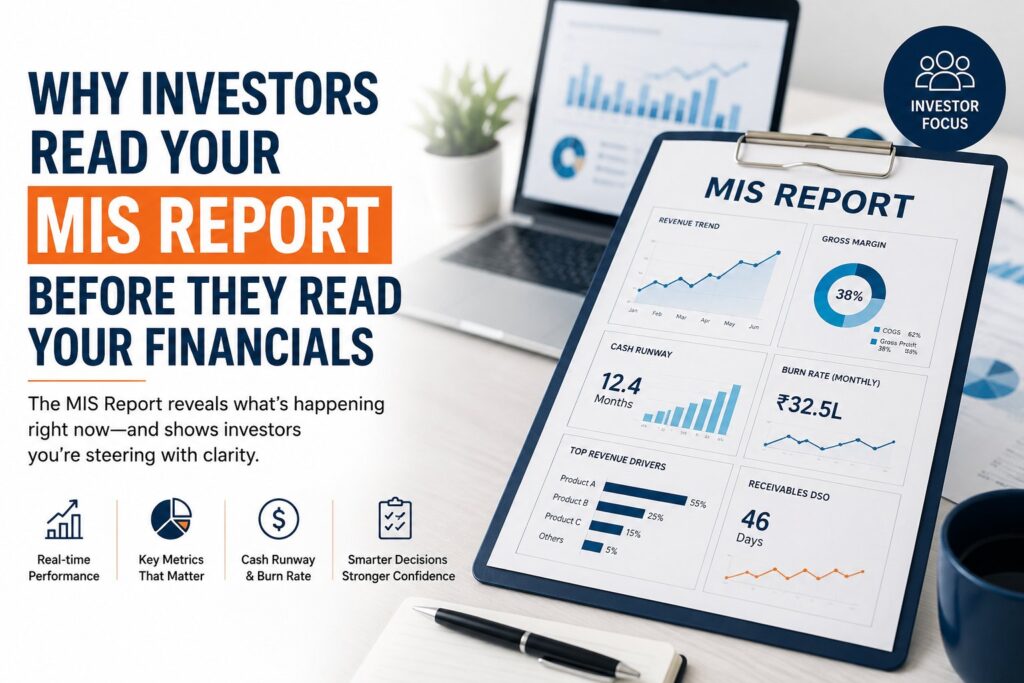
- A one-page summary up top: revenue, burn, cash position, runway. The four numbers an investor checks first.
- A P&L with actuals against plan, not just what happened, but how far off you were from what you said would happen.
- A cash flow view with a short-term forecast, a rolling look at the next several weeks or months rather than just today’s balance.
- Key customer and unit economics (CAC, retention, revenue concentration, whatever’s relevant to your model).
- Operational metrics that actually matter for your business. Varies a lot by sector, and that’s fine, it should look like your business, not a downloaded template.
- A short forward note on risks you’re watching and what’s the priority next.
That’s about it. You don’t need forty tabs and a dozen dashboards. You need it to be accurate, consistent, and readable by someone who’s never sat inside your company.
How Often Should You Actually Be Doing This
Monthly’s the norm once you’re funded or actively raising. Quarterly can work if you’re early stage and monthly would be overkill for the size of the operation.
But here’s the thing investors actually respond to: consistency, not sophistication. A founder who reliably shows up with a simple, honest MIS every month signals more discipline than one who occasionally produces something elaborate three weeks late.
One practical nudge: start this habit before you’re fundraising, not during it. Trying to piece together twelve months of clean MIS history in the middle of a raise, while also trying to close the round, is one of the more common (and easily avoidable) scrambles founders put themselves through.
Where This Actually Leaves You
Annual financials prove you’re compliant. Your MIS proves you’re in control.
Investors aren’t really choosing between the two documents. They’re using your MIS to decide how much to trust the financials, and how much to trust the person sitting across from them.
If you don’t have a monthly MIS process right now, or you’re not sure the reports you do have would survive real scrutiny, that’s fixable. Much better to sort it out now, before a term sheet’s on the table, than to discover the gap mid-diligence.
Frequently Asked Questions
What is an MIS report in simple terms? A monthly or quarterly internal report showing how your business is doing right now: revenue, cash, burn, key operating metrics. Different from your annual financials, which give the audited, backward-looking view.
Is an MIS report the same as a financial statement? No. Financial statements (P&L, balance sheet, cash flow) are usually prepared annually for compliance and audit. An MIS is built on those same books but comes more often and is formatted specifically for investor and board decisions.
How often should a startup prepare an MIS report? Monthly, if you’re funded or actively raising. Quarterly can work fine for earlier-stage companies, as long as it’s consistent.
What should an MIS report include for investors? At minimum: a summary of revenue, burn, cash, and runway, a P&L with variance against plan, a cash flow view with a short forecast, key customer or unit economics, and a short note on risks and priorities ahead.
Do I need an MIS report if I’m pre-seed and not yet fundraising? Not urgent, but worth starting early anyway. Build the habit before you’re under pressure, and you walk into your first real raise with a track record already sitting there, rather than trying to build one overnight.
If you’re gearing up for a raise and want a second opinion on whether your current reporting would hold up under investor diligence, get in touch with Ocellus for a free consultation.