CAPEX Proposal: Meaning, Components, and Approval Process
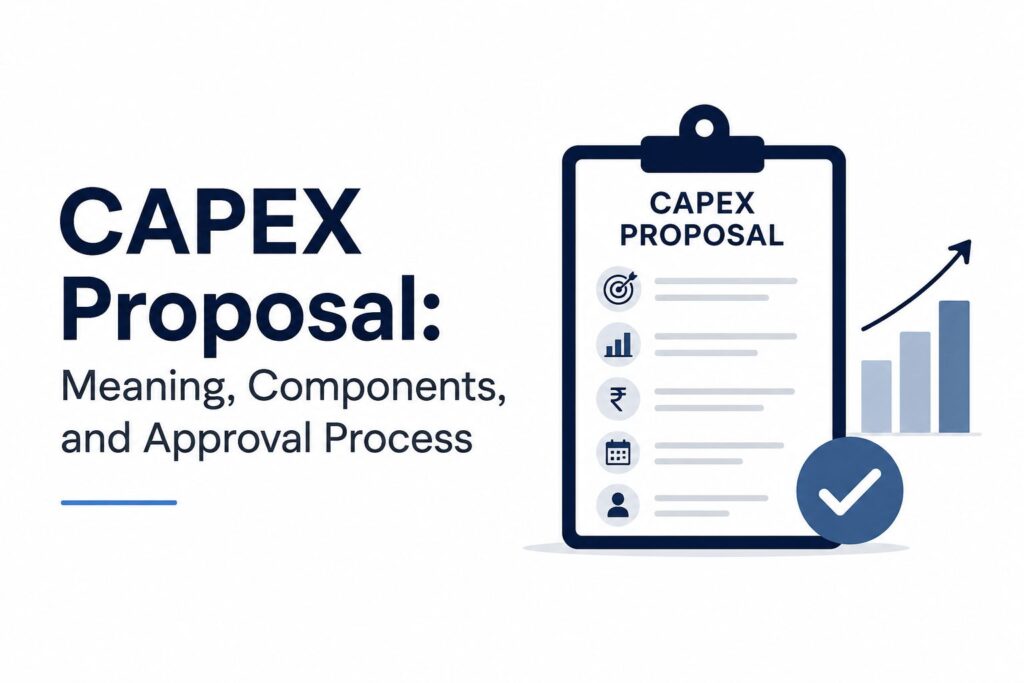
A CAPEX proposal is a formal request to invest company capital in an asset, project, infrastructure, technology, or other long-term investment. It explains why the investment is required, how much it will cost, what benefits are expected, what risks are involved, and who will be accountable for the outcome.
A strong CAPEX proposal gives management enough information to decide whether the investment should be approved, modified, deferred, or rejected.
Unlike a simple purchase request, a CAPEX proposal should demonstrate the business case behind the investment. The objective is not merely to justify spending money, but to show why committing capital to this particular investment is expected to create sufficient business value.
CAPEX Proposal: What Is It?
A CAPEX proposal is a structured document submitted for approval before a significant capital expenditure is committed.
Depending on the organization, it may be prepared by finance, operations, engineering, IT, procurement, or another business function requesting the investment.
A typical CAPEX proposal explains:
- The business problem or opportunity
- The proposed investment
- The amount of capital required
- Available alternatives
- Expected financial and operational benefits
- Key assumptions
- Investment returns
- Risks and mitigation measures
- Implementation timeline
- Funding requirements
- Person or department responsible for the investment
The level of detail should generally increase with the size, risk, and strategic importance of the investment.
A small replacement purchase may require a relatively simple justification, while a major plant expansion, technology transformation, or new facility may require detailed financial modelling, sensitivity analysis, risk assessment, and senior management or board approval.
What Should a CAPEX Proposal Include?
There is no single universal CAPEX proposal format that applies to every organization. However, a well-structured proposal should normally address the following components.
| Component | What it should answer |
|---|---|
| Business need | Why is the investment required? |
| Investment amount | How much capital is required? |
| Alternatives | What alternatives were considered? |
| Expected benefits | What will the investment achieve? |
| ROI | What financial return is expected? |
| Payback | When is the capital expected to be recovered? |
| Risks | What could cause the investment to underperform? |
| Timeline | When will the asset or project become operational? |
| Owner | Who is accountable for delivering the expected results? |
1. Business Need
The proposal should begin by explaining why the investment is necessary.
The business need could relate to:
- Capacity constraints
- Asset replacement
- Business expansion
- Cost reduction
- Operational efficiency
- Technology modernization
- Regulatory requirements
- Safety requirements
- New product or service capabilities
The proposal should focus on the underlying business problem rather than simply stating that a particular asset needs to be purchased.
2. Investment Amount
The proposal should clearly state the total capital requirement.
This should include more than the supplier’s quoted purchase price where applicable.
Relevant costs may include:
- Asset or equipment purchase
- Installation
- Infrastructure
- Implementation
- Engineering
- Commissioning
- Training
- Integration
- Initial setup
- Other directly attributable project costs
For larger investments, the proposal should provide a detailed CAPEX breakdown so decision-makers can understand where the capital will be deployed.
3. Alternatives Considered
A strong CAPEX proposal should demonstrate that the recommended investment is not simply the first solution considered.
Alternatives could include:
- Repairing an existing asset
- Upgrading existing equipment
- Leasing
- Outsourcing
- Purchasing a lower-cost alternative
- Using existing capacity more efficiently
- Phasing the investment
- Delaying the investment
The proposal should explain why the recommended option provides the best combination of cost, return, risk, operational suitability, and strategic value.
4. Expected Benefits
The proposal should clearly explain what the business expects to gain from the investment.
Depending on the project, benefits may include:
- Additional revenue
- Increased production capacity
- Cost savings
- Improved productivity
- Reduced downtime
- Lower maintenance costs
- Improved quality
- Regulatory compliance
- Improved customer service
- New business capabilities
Where possible, benefits should be quantified rather than described only in general terms.
For example, instead of saying:
“The new equipment will improve efficiency.”
A stronger proposal might state:
“The new equipment is expected to increase production capacity by 20% and reduce average processing costs by 8%.”
This makes the investment easier to evaluate after implementation.
5. ROI and Financial Returns
The financial case should show how the proposed CAPEX is expected to generate value.
Depending on the type of investment, the proposal may include:
- Return on Investment (ROI)
- Payback period
- Net Present Value (NPV)
- Internal Rate of Return (IRR)
- Incremental revenue
- Cost savings
- Margin improvement
- Cash-flow impact
The assumptions behind these calculations should also be clearly documented.
An attractive ROI based on unrealistic utilization or revenue assumptions does not necessarily represent a good investment.
6. Payback Period
The payback period indicates how long it is expected to take for the investment to recover its initial cost through incremental cash flows or savings.
For example, if a ₹10 crore investment is expected to generate ₹2.5 crore of incremental annual cash benefits, the simple payback period would be approximately four years.
However, payback should not be considered in isolation. A project with a longer payback period may still create greater long-term value than a project with a shorter payback period.
7. Risks and Mitigation
Every CAPEX proposal should identify the factors that could prevent the investment from delivering its expected results.
Potential risks include:
- Cost overruns
- Procurement delays
- Construction or implementation delays
- Lower-than-expected demand
- Low asset utilization
- Vendor dependency
- Technology obsolescence
- Regulatory changes
- Higher operating costs
- Delayed commissioning
The proposal should also explain how material risks will be mitigated.
8. Implementation Timeline
The CAPEX proposal should establish when the investment is expected to move from approval to operation.
A typical timeline may include:
Approval → Procurement → Delivery → Installation → Commissioning → Operational Deployment
For larger projects, the proposal should identify major milestones and dependencies.
Implementation delays can materially affect the financial return of a project, particularly when the investment is expected to generate revenue or cost savings shortly after commissioning.
9. CAPEX Owner
Every significant CAPEX investment should have a clearly identified owner.
The owner should be accountable for delivering the expected business outcome, not simply completing the purchase.
Depending on the investment, this may be:
- Business unit head
- Plant head
- Operations leader
- CIO or IT head
- Engineering head
- Project manager
Clear ownership becomes particularly important during the post-implementation review, when actual performance is compared with the original CAPEX proposal.
CAPEX Proposal vs CAPEX Request
A CAPEX request and a CAPEX proposal are related, but they are not necessarily the same thing.
A CAPEX request generally initiates the process by asking for authorization to spend capital.
A CAPEX proposal provides the business case and supporting analysis needed to evaluate that request.
In simple terms:
CAPEX Request:
“We need ₹5 crore to purchase this equipment.”
CAPEX Proposal:
“We need ₹5 crore for this equipment because the business has a capacity constraint, three alternatives were evaluated, this option provides the strongest expected return, and the investment is expected to increase capacity by 25% with a four-year payback.”
The exact terminology varies between organizations, and some companies may use “CAPEX request,” “CAPEX proposal,” and “capital investment proposal” interchangeably.
What matters is that the approval document contains enough information for management to make an informed capital allocation decision.
CAPEX Proposal Approval Process
A typical CAPEX proposal approval process moves through several stages.
1. Proposal Initiation
The requesting department identifies a business requirement and prepares the initial CAPEX proposal.
2. Business and Technical Review
Relevant operational, engineering, IT, or business teams review the proposed investment for technical feasibility and operational suitability.
3. Financial Review
Finance evaluates:
- Investment cost
- Financial assumptions
- Expected returns
- Cash-flow impact
- Budget availability
- Alternative options
- Risks
The finance review should challenge the assumptions behind the proposal rather than simply verify that the calculations are mathematically correct.
4. Management Approval
The proposal is submitted to the appropriate approval authority based on the organization’s CAPEX thresholds and delegation of authority.
Lower-value investments may require department-level approval, while larger or strategically important investments may require CFO, CEO, management committee, or board approval.
5. Procurement and Execution
Once approved, the organization proceeds with procurement, contracting, implementation, and other execution activities.
The approved CAPEX amount and scope should remain the reference point for monitoring subsequent spending.
6. Monitoring and Post-Implementation Review
Approval should not mark the end of the CAPEX process.
After implementation, management should compare:
- Approved CAPEX vs actual spending
- Planned timeline vs actual timeline
- Expected utilization vs actual utilization
- Expected revenue or savings vs actual results
- Expected returns vs actual returns
This creates accountability and helps the organization improve future CAPEX decisions.
What Makes a Good CAPEX Proposal?
A strong CAPEX proposal should allow a decision-maker to answer five questions quickly:
- Why do we need this investment?
- Why is this the best option?
- How much will it really cost?
- What return or business benefit should we expect?
- Who will be accountable for delivering that outcome?
If these questions cannot be answered clearly, the proposal may not yet be ready for approval.
The best CAPEX proposals are not necessarily the longest. They are the ones that make the investment rationale, assumptions, risks, expected returns, and accountability easy to understand and challenge.
A disciplined CAPEX proposal process helps organizations move from simply approving expenditure to making better capital allocation decisions.