Accounting Outsourcing: Complete Guide for Businesses
Accounting is one of those business functions that has to be done accurately, consistently, and on time, but that doesn’t necessarily mean you need to build a large in-house accounting team to handle it.
Accounting outsourcing allows businesses to hand over some or all of their accounting activities to an external provider. Depending on the business, this can include everything from day-to-day bookkeeping and bank reconciliations to accounts payable, accounts receivable, payroll accounting, and financial reporting.
For small and growing businesses, outsourcing can provide access to accounting expertise without the cost and management requirements of building a larger internal team. Larger businesses may also outsource specific accounting functions to manage workloads, access specialised expertise, or support expansion.
This guide explains what accounting outsourcing is, which accounting functions can be outsourced, how the process works, what it costs, and what businesses should consider when choosing an outsourcing provider.
What Is Accounting Outsourcing?
Accounting outsourcing is the practice of hiring an external company or accounting team to manage specific accounting functions or an organisation’s accounting operations as a whole.
Instead of hiring employees to perform every accounting task internally, a business works with an external provider that handles the agreed-upon responsibilities. The scope can be as narrow as basic bookkeeping or as broad as managing day-to-day accounting, reconciliations, reporting, and other financial processes.
For example, a small business might outsource its bookkeeping and bank reconciliation while keeping financial decision-making in-house. Another company may outsource its entire accounting function, including accounts payable, accounts receivable, month-end closing, and financial reporting.
The important point is that outsourcing does not necessarily mean handing over all accounting responsibilities. Businesses can choose which functions to outsource based on their workload, internal expertise, budget, and operational requirements.
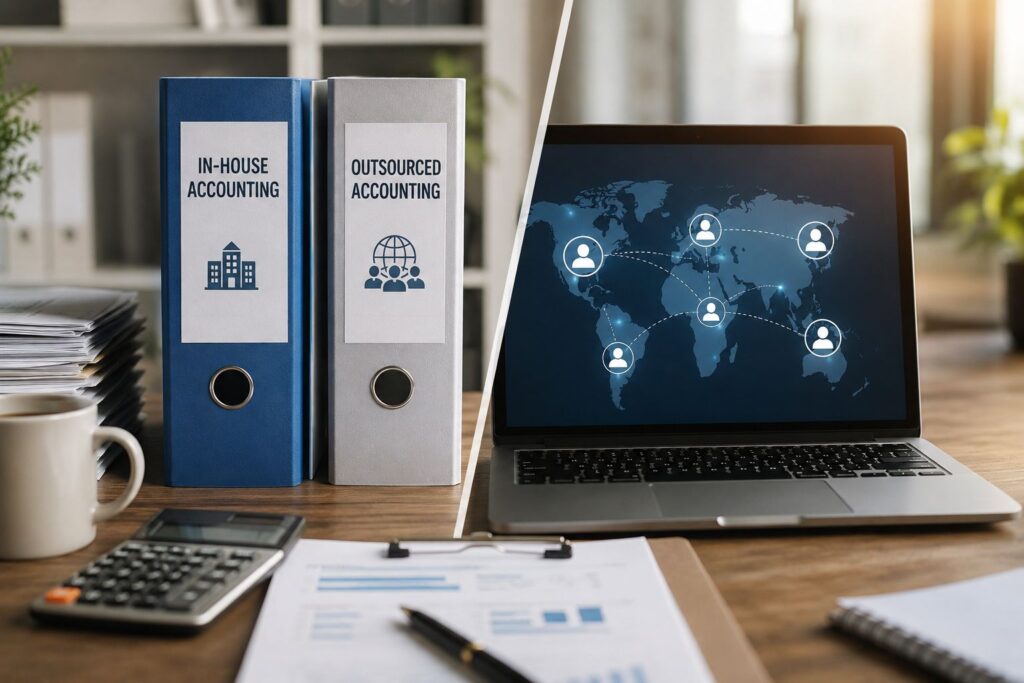
Accounting Outsourcing vs. In-House Accounting
With an in-house model, the business hires and manages its own accounting employees. This means the company is responsible for salaries, benefits, recruitment, training, software, equipment, and day-to-day management.
With outsourced accounting, these responsibilities are largely handled by the service provider. The business pays for the agreed accounting services and works with the external team to provide the information, approvals, and access required to complete the work.
| Factor | In-House Accounting | Outsourced Accounting |
|---|---|---|
| Accounting staff | Hired directly by the business | Provided by an external company |
| Recruitment | Business handles hiring | Provider handles staffing |
| Employee overhead | Salaries, benefits and other costs | Usually included in service pricing |
| Expertise | Depends on internal team | Access to provider’s accounting team |
| Scalability | May require additional hiring | Services can generally be scaled |
| Management | Directly managed internally | Managed through the outsourcing provider |
| Scope | Determined by internal resources | Can be customised based on requirements |
Neither model is automatically better. A large organisation with a substantial finance department may benefit from keeping most accounting functions in-house, while a growing business may find that accounting services outsourcing provides a more flexible way to manage its financial operations.
What Accounting Functions Can Be Outsourced?
Businesses can outsource almost any routine or process-driven accounting activity, depending on their requirements and the capabilities of the service provider.
Some companies outsource only bookkeeping, while others use a provider to manage a much broader range of accounting processes.
Commonly outsourced accounting functions include:
| Accounting Function | What It Typically Includes |
|---|---|
| Bookkeeping | Recording, categorising and maintaining financial transactions |
| Accounts payable | Processing supplier invoices and managing payments |
| Accounts receivable | Customer invoicing, payment tracking and receivables management |
| Bank reconciliation | Matching accounting records with bank transactions |
| General ledger | Maintaining and reviewing financial accounts |
| Payroll accounting | Payroll processing and related accounting entries |
| Financial reporting | Preparing profit and loss statements, balance sheets and other reports |
| Tax support | Maintaining records and preparing information required for tax filings |
| Management reporting | Providing financial information for business decision-making |
| Month-end closing | Reconciliations, adjustments and closing monthly accounts |
Bookkeeping and Transaction Processing
Bookkeeping is one of the most common areas businesses outsource. It involves recording and categorising day-to-day financial transactions and keeping accounting records up to date.
Depending on the business, this may include recording sales and expenses, processing invoices, categorising bank transactions, maintaining ledgers, and reconciling accounts.
Outsourcing bookkeeping can be particularly useful when business owners or operational employees are spending significant amounts of time maintaining financial records instead of focusing on their core responsibilities.
Accounts Payable and Accounts Receivable
Accounts payable involves managing money the business owes to suppliers and other vendors. Outsourced support can include receiving and processing invoices, maintaining vendor records, tracking outstanding payments, and preparing payments for approval.
Accounts receivable focuses on money owed to the business. This can include preparing customer invoices, recording payments, tracking outstanding receivables, and generating ageing reports.
For businesses with a high volume of invoices and transactions, outsourcing these processes can reduce the administrative workload on internal employees.
Bank Reconciliation and General Ledger
Bank reconciliation involves comparing the transactions recorded in the accounting system with the corresponding bank statements and identifying discrepancies.
Regular reconciliation helps businesses maintain accurate financial records and identify missing, duplicated, or incorrectly recorded transactions.
The general ledger is another fundamental part of accounting. It contains the accounts used to record the financial activity of the business and forms the basis for many financial reports.
Financial Reporting
Businesses can also outsource the preparation of regular financial reports.
Depending on the scope of the engagement, this may include:
- Profit and loss statements
- Balance sheets
- Cash flow reports
- Accounts receivable ageing reports
- Accounts payable ageing reports
- Expense reports
- Management reports
Regular reporting gives business owners and management a clearer view of financial performance and can make it easier to identify changes in revenue, expenses, profitability, and cash flow.
Payroll and Tax Support
Some accounting outsourcing providers also support payroll-related accounting and tax processes.
Payroll support may include recording payroll transactions, maintaining payroll-related accounts, and preparing reports. Tax-related support can include maintaining accurate accounting records and providing the financial information required by the business’s tax or compliance professionals.
The exact scope varies significantly between providers and jurisdictions, so businesses should clearly establish which payroll and tax responsibilities are included before signing an outsourcing agreement.
How Does Accounting Outsourcing Work?
Accounting outsourcing usually follows a structured process. The exact workflow depends on the size of the business, the accounting functions being outsourced, and the systems already in place.
A typical engagement involves the following steps.
1. Assess Your Accounting Requirements
The first step is to determine which accounting activities need to be outsourced.
A business may already have an accountant handling some functions while struggling with others. For example, bookkeeping may be managed internally while accounts receivable and monthly reporting are taking too much time.
The provider should understand the existing accounting setup, transaction volume, reporting requirements, software, and internal responsibilities before recommending a scope of work.
2. Define the Scope of Services
Once the requirements are understood, the business and outsourcing provider agree on which functions will be handled externally.
This could range from a limited bookkeeping engagement to a complete accounting function covering:
- Bookkeeping
- Accounts payable
- Accounts receivable
- Bank reconciliation
- Payroll accounting
- Month-end closing
- Financial reporting
- Management reporting
Clearly defining the scope at this stage helps avoid confusion about what is included in the service and what remains the responsibility of the business.
3. Set Up Systems and Access
The outsourcing team then gets access to the systems and information required to perform the work.
This may include accounting software, bank feeds, invoices, receipts, payroll information, financial records, and other relevant documentation.
Access should be provided according to the responsibilities of each team member. Businesses should avoid giving unnecessary access to sensitive financial information and should use appropriate permissions and security controls.
4. Transition the Accounting Work
The provider takes over the agreed accounting activities and reviews the existing records and processes.
Depending on the situation, the transition may involve:
- Reviewing historical accounting records
- Checking opening balances
- Completing pending reconciliations
- Understanding existing accounting procedures
- Organising financial documents
- Establishing reporting schedules
- Identifying outstanding accounting issues
A well-managed transition is important because errors or incomplete records from the beginning can create problems later.
5. Manage Accounting Operations
Once the transition is complete, the outsourced team handles the agreed accounting activities on an ongoing basis.
Transactions are recorded, accounts are reconciled, invoices are processed, and financial reports are prepared according to the agreed schedule.
The business typically retains responsibility for decisions and approvals that require management involvement, while the outsourcing team handles the operational accounting work.
6. Review Reports and Performance
Accounting outsourcing should not be treated as a process that ends once the work is handed over.
Regular communication between the business and the accounting provider helps ensure that the service continues to meet the company’s needs.
Businesses may periodically review:
- Accuracy of accounting records
- Reporting quality
- Turnaround times
- Outstanding receivables and payables
- Changes in transaction volume
- Additional accounting requirements
As the business grows, the scope of accounting outsourcing services can also be adjusted.
What Types of Businesses Outsource Accounting?
Accounting outsourcing is used by businesses of different sizes and across many industries. The decision to outsource is usually driven less by the type of business and more by its accounting workload, internal resources, complexity, and growth plans.
Startups and Small Businesses
Early-stage businesses often don’t need a large finance department, but they still need accurate financial records.
Outsourcing allows founders to delegate routine accounting work without immediately hiring a full-time accounting team.
Small and Medium-Sized Businesses
As a business grows, the volume of invoices, expenses, payments, payroll transactions, and financial reporting can increase significantly.
An external accounting team can take over routine work while internal employees focus on operations and management.
E-commerce Businesses
E-commerce companies can have large numbers of transactions across multiple payment gateways, marketplaces, currencies, and sales channels.
Keeping these transactions properly recorded and reconciled can become increasingly time-consuming as sales grow.
Professional Services Businesses
Consultancies, agencies, law firms, IT companies, and other professional services businesses may have relatively straightforward operations but still require regular bookkeeping, invoicing, expense tracking, and financial reporting.
Outsourcing can allow the business to maintain these processes without building a large internal accounting function.
Growing and Expanding Businesses
A business entering a new market or adding new entities may need additional accounting capacity without wanting to immediately expand its permanent finance team.
Outsourcing can provide additional support during periods of growth while allowing the company to adjust its accounting requirements over time.
Benefits of Accounting Outsourcing
The reasons businesses choose accounting outsourcing vary, but several potential benefits apply across different business types.
Lower Accounting Overhead
Maintaining an internal accounting team involves more than employee salaries. Businesses may also have recruitment, training, benefits, software, equipment, and management costs.
Outsourcing can provide access to accounting professionals through a service model rather than requiring the business to build the entire function internally.
However, the actual cost advantage depends on the scope of services and the size and complexity of the business.
Access to Accounting Expertise
An outsourced accounting provider may have a team with experience across different accounting processes, industries, and software platforms.
This can be particularly useful for businesses that don’t have the resources to hire specialists for every accounting function.
Instead of relying on one person to handle everything, a business may have access to different levels of accounting expertise within the same provider.
Save Time for Business Owners and Employees
Accounting can consume a considerable amount of time when it is handled by business owners or employees whose primary responsibilities lie elsewhere.
Routine activities such as recording transactions, reconciling accounts, processing invoices, and preparing reports can be delegated to an external team.
This allows internal staff to spend more time on activities that directly contribute to running and growing the business.
Improve Financial Visibility
Accurate accounting records are useful only when businesses can actually use them to understand their financial position.
Regular financial reporting can help management track revenue, expenses, profitability, outstanding receivables, liabilities, and cash flow.
With a consistent reporting process, business owners can make decisions using current financial information rather than relying on incomplete records or estimates.
Support Business Growth
Accounting requirements generally increase as a business grows.
More customers can mean more invoices. More employees can mean more payroll work. Additional locations or entities can create additional reporting requirements.
Outsourcing allows the accounting function to expand alongside the business without every increase in workload requiring an immediate internal hire.
Allow Businesses to Focus on Core Operations
For many businesses, accounting is essential but isn’t the activity that generates their competitive advantage.
Outsourcing routine accounting work allows management and employees to concentrate on areas such as sales, product development, customer service, operations, and business strategy while accounting professionals handle the financial processes.
How Much Does Accounting Outsourcing Cost?
There is no single price for accounting outsourcing because the cost depends heavily on the scope and complexity of the work involved.
A business that only needs monthly bookkeeping will have very different requirements from a company looking for a complete outsourced accounting function with accounts payable, accounts receivable, payroll, month-end closing, and management reporting.
Some of the factors that can influence the cost include:
- Number of monthly transactions
- Number of bank and credit card accounts
- Number of employees
- Number of business entities
- Accounts payable and receivable volume
- Payroll requirements
- Complexity of accounting
- Accounting software being used
- Frequency of financial reporting
- Tax and compliance requirements
- Level of management reporting required
- Amount of historical data that needs to be cleaned up
Common Accounting Outsourcing Pricing Models
Providers generally use one of several pricing approaches.
Fixed monthly pricing charges a recurring fee for an agreed scope of accounting services. This can make budgeting easier when the workload is relatively predictable.
Transaction-based pricing is linked to the volume of transactions or specific accounting activities being handled.
Hourly pricing charges based on the amount of time spent by the accounting team and may be appropriate for ad hoc or irregular requirements.
Custom pricing is common when a business requires multiple accounting functions or has more complex reporting and operational requirements.
When comparing accounting outsourcing services, businesses should look beyond the monthly price and compare exactly what is included. A lower-priced package may cover only basic bookkeeping, while a more comprehensive service may include reconciliations, reporting, AP/AR, and other accounting functions.
In-House vs Outsourced Accounting
Whether a business should outsource accounting depends on its size, transaction volume, internal expertise, budget, and reporting requirements. There is no single model that works for every business.
| Factor | In-House Accounting | Outsourced Accounting |
|---|---|---|
| Staffing | Business hires and manages accounting employees | Accounting team is provided externally |
| Overhead | Salaries, benefits, recruitment and other employee costs | Service fee based on agreed scope |
| Expertise | Depends on the internal team | Access to a broader accounting team |
| Scalability | Usually requires additional hiring | Scope can generally be increased as needed |
| Management | Directly managed by the business | Managed through the outsourcing provider |
| Control | Direct day-to-day control | Managed through defined processes and access |
| Best suited for | Businesses with substantial internal finance requirements | Businesses seeking flexible accounting support |
When In-House Accounting May Make Sense
An internal accounting team may be appropriate when a business has a large and complex finance operation that requires continuous internal involvement.
For example, a larger organisation may have dedicated employees for accounts payable, accounts receivable, financial control, payroll, management reporting, and other finance functions.
Having these roles internally can provide close integration between the finance department and the rest of the organisation.
When Outsourced Accounting May Make Sense
Outsourcing can be particularly useful when a business doesn’t have enough accounting work to justify a larger full-time team or when its existing employees are struggling to keep up with the workload.
It can also make sense when a company needs additional expertise, wants to improve its reporting processes, or needs accounting support that can scale as the business grows.
The decision doesn’t have to be all or nothing. A business can keep certain accounting responsibilities in-house while outsourcing specific functions such as bookkeeping, accounts payable, payroll accounting, or financial reporting.
Accounting Outsourcing in India
India has become a major destination for businesses looking to outsource accounting and other finance-related processes.
The country has a large pool of accounting and finance professionals, established business process outsourcing capabilities, and extensive experience supporting businesses in international markets.
For businesses considering accounting outsourcing in India, some of the factors that may make the country attractive include:
Large Talent Pool
India has a substantial workforce of accounting and finance professionals, making it possible for outsourcing providers to build teams with different levels of expertise.
This can be useful for businesses that need more than basic bookkeeping support and require specialised accounting knowledge.
Cost Efficiency
One of the reasons companies consider outsourcing accounting operations to India is the potential to access professional services at a lower overall operating cost than maintaining an equivalent team in some higher-cost markets.
However, cost should not be the only consideration. The provider’s accounting expertise, processes, communication, security practices, and quality of service are equally important.
Experience With International Businesses
Many Indian accounting outsourcing providers work with businesses located in markets such as the United States, United Kingdom, Australia, and other countries.
This experience can be valuable when an outsourcing team needs to work with international accounting systems, reporting requirements, currencies, and business processes.
Technology and Remote Collaboration
Modern accounting software and cloud-based collaboration tools allow businesses and external accounting teams to work together without being in the same physical location.
Accounting records, invoices, reports, and other documents can be accessed and managed through appropriate digital systems, while communication can take place through email, project management platforms, video calls, and other collaboration tools.
Is Accounting Outsourcing to India Secure?
Security should be an important consideration when outsourcing accounting work to any country.
Accounting teams may have access to sensitive financial information, so businesses should evaluate a provider’s security practices before sharing data.
Important areas to consider include:
- User access permissions
- Data confidentiality
- Secure document sharing
- Password and account security
- Backup procedures
- Confidentiality agreements
- Employee access controls
- Accounting software permissions
Businesses should provide each user with only the access required to perform their role and establish clear procedures for handling sensitive financial information.
How to Choose an Accounting Outsourcing Company
Choosing an accounting outsourcing provider shouldn’t come down to price alone. The provider will potentially have access to financial records, accounting systems, invoices, payroll information, and other sensitive business data.
A good evaluation should consider both the provider’s accounting capabilities and the way it operates.
Check Relevant Accounting Experience
Start by looking at the provider’s experience with businesses similar to yours.
An accounting provider that understands your industry, business model, transaction volumes, and reporting requirements may require less time to understand your processes and can potentially identify issues more quickly.
Understand What Services Are Included
Ask exactly what the quoted fee covers.
For example, does the service include only bookkeeping, or does it also cover bank reconciliation, accounts payable, accounts receivable, month-end closing, and financial reporting?
A clear scope makes it easier to compare providers and prevents unexpected charges later.
Check Accounting Software Experience
The provider should be comfortable working with the accounting software used by your business.
Depending on your requirements, this could include platforms such as QuickBooks, Xero, Zoho Books, Sage, or other accounting systems.
If you are planning to change accounting software, the provider’s experience with migration and system setup may also be relevant.
Understand Communication and Reporting
Good accounting isn’t just about entering transactions correctly. The business also needs to be able to communicate with the accounting team and receive useful financial information on time.
Before choosing a provider, establish:
- Who will be your primary contact?
- How frequently will you communicate?
- How quickly are queries typically addressed?
- How often will financial reports be provided?
- Who reviews the accounts?
- How are urgent issues escalated?
Ask About Data Security
Because outsourced accounting involves sensitive financial information, ask how the provider manages access and protects business data.
Look for clear processes around user permissions, confidentiality, document sharing, backups, and access to accounting software.
Understand Pricing and Additional Charges
Make sure you understand both the recurring fee and what falls outside the agreed scope.
For example, additional charges may apply for:
- Historical bookkeeping cleanup
- Additional entities
- Higher transaction volumes
- Additional reporting
- Payroll processing
- Tax-related work
- Ad hoc accounting support
A transparent pricing structure makes it easier to budget for accounting services.
Check Whether the Provider Can Scale
Your accounting requirements today may not be the same six or twelve months from now.
Ask whether the provider can accommodate higher transaction volumes, additional employees, new locations, additional entities, or new accounting requirements as the business grows.
Ask About the Transition Process
Finally, understand how the provider plans to take over the accounting work.
A structured transition should cover existing records, opening balances, outstanding reconciliations, accounting processes, access requirements, and reporting expectations.
A provider with a clearly defined onboarding process is generally easier to work with than one that simply asks for access to the accounting software and starts working without a proper handover.
Is Accounting Outsourcing Right for Your Business?
Accounting outsourcing can be a practical option for businesses that need reliable accounting support without building a large internal finance team.
It may be worth considering if:
- Your accounting workload is taking too much time
- Business owners are handling routine accounting tasks
- Your internal accounting team is overloaded
- You need more regular financial reporting
- Your business is growing rapidly
- You need additional accounting expertise
- Hiring a larger internal team isn’t currently practical
- You want accounting support that can scale with your business
On the other hand, businesses with large, established finance departments or highly specialised internal requirements may find that keeping most accounting functions in-house makes more sense.
The right approach can also be a combination of both. A company might retain financial management and decision-making internally while outsourcing accounting services such as bookkeeping, reconciliations, accounts payable, or financial reporting.
Ultimately, the decision should be based on the company’s workload, complexity, internal capabilities, cost considerations, and the level of financial control and support it requires.
Frequently Asked Questions About Accounting Outsourcing
What is accounting outsourcing?
Accounting outsourcing is the practice of hiring an external accounting company or team to handle some or all of a business’s accounting functions. This can include bookkeeping, accounts payable, accounts receivable, bank reconciliation, payroll accounting, financial reporting, and other accounting processes.
What accounting services can be outsourced?
Businesses can outsource a wide range of accounting services, including bookkeeping, accounts payable, accounts receivable, bank reconciliation, general ledger management, payroll accounting, month-end closing, financial reporting, and management reporting. The exact scope depends on the business’s requirements and the outsourcing provider.
Why do businesses outsource accounting?
Businesses commonly outsource accounting to reduce administrative workload, access accounting expertise, manage costs, improve financial reporting, and avoid the need to build a larger internal accounting team. Outsourcing can also provide additional accounting capacity as a business grows.
How much does accounting outsourcing cost?
The cost of accounting outsourcing varies depending on factors such as transaction volume, number of accounts, number of employees, services required, accounting software, reporting requirements, and business complexity. Providers may charge a fixed monthly fee, hourly rate, transaction-based fee, or customised price.
Is accounting outsourcing cheaper than hiring an accountant?
It can be, depending on the business’s requirements. Outsourcing can reduce some costs associated with hiring and maintaining an internal employee, including recruitment, benefits, training, and other overheads. However, the comparison depends on the scope of work and level of accounting support required.
Is accounting outsourcing suitable for small businesses?
Yes. Small businesses can use outsourced accounting to manage routine bookkeeping and financial administration without necessarily hiring a full-time accounting team. The business can keep financial decisions and management responsibilities in-house while an external team handles the agreed accounting work.
Can I outsource only part of my accounting?
Yes. Businesses do not have to outsource their entire accounting function. A company can outsource specific activities such as bookkeeping, accounts payable, accounts receivable, payroll accounting, or financial reporting while keeping other responsibilities in-house.
How does accounting outsourcing work?
Accounting outsourcing typically begins with an assessment of the business’s accounting requirements. The provider and business then define the scope of services, set up system access, transition existing records and processes, and establish an ongoing workflow for accounting and reporting.
Is accounting outsourcing in India a good option?
India is a popular destination for accounting outsourcing because of its large pool of accounting and finance professionals, established outsourcing industry, and experience supporting businesses in international markets. Businesses should still evaluate individual providers based on expertise, security, communication, pricing, and service quality.
Is outsourced accounting secure?
Outsourced accounting can be managed securely when appropriate controls are in place. Businesses should evaluate a provider’s data security practices, user permissions, confidentiality procedures, document-sharing methods, backups, and access controls before providing access to financial information.
What is the difference between bookkeeping and accounting outsourcing?
Bookkeeping primarily involves recording and organising financial transactions, while accounting can cover a broader range of activities such as reconciliations, financial reporting, month-end closing, and financial analysis. Accounting outsourcing can therefore include bookkeeping as well as additional accounting functions.
How do I choose an accounting outsourcing company?
Look at the provider’s accounting experience, services offered, software expertise, pricing, communication process, data security practices, scalability, and onboarding process. Also confirm exactly which services are included in the quoted price and whether additional charges apply for work outside the agreed scope.
Conclusion
Accounting outsourcing can cover much more than basic bookkeeping. Businesses can outsource individual accounting functions or engage an external team to manage a broader part of their accounting operations.
The right approach depends on the business’s size, transaction volume, internal expertise, reporting requirements, and growth plans. For many small and growing businesses, outsourcing can provide access to accounting expertise while reducing the need to build a larger internal team.
The most important step is to clearly define what you need outsourced and choose a provider based on capability, scope, security, communication, scalability, and value, not simply the lowest price.
If you’re considering outsourcing your accounting function, reviewing the specific accounting outsourcing services available can help you determine which parts of your accounting operations are best suited for external support.