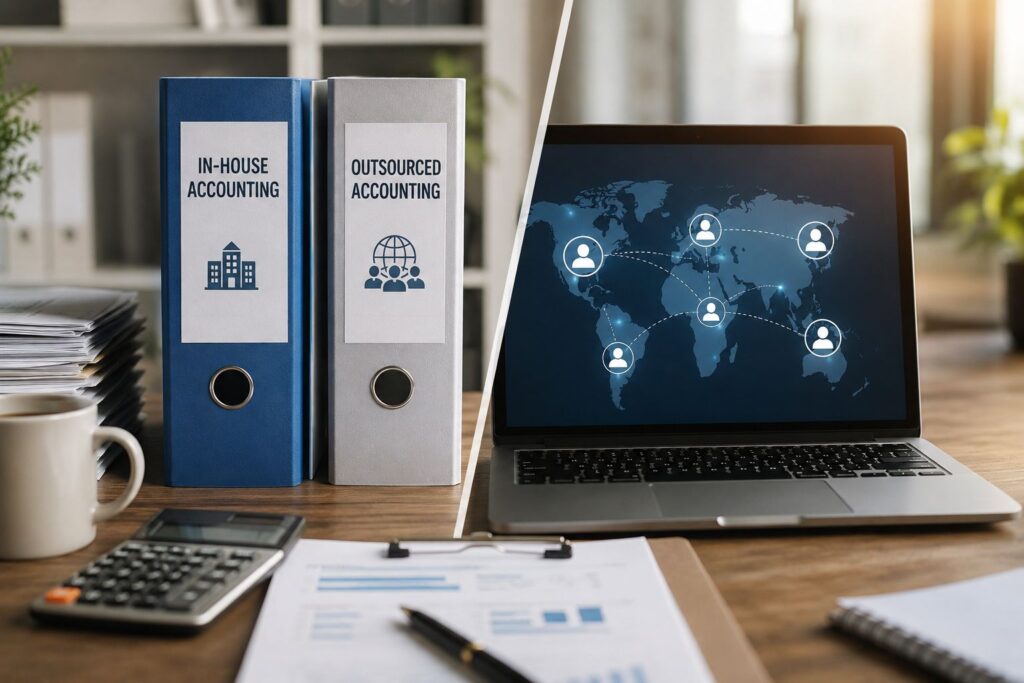
Accounting Outsourcing vs In-House Accounting: Which Is Better?
For many businesses, accounting starts as a simple internal function. An owner or manager handles the books, a small team takes care of invoices and payments, and an accountant manages the numbers. But as the business grows, accounting can become increasingly time-consuming and expensive to manage internally.
At that point, businesses often face a choice: should they continue building an in-house accounting team, or outsource their accounting to an external provider?
Both approaches have advantages. An in-house team gives a business direct control over its accounting function, while accounting outsourcing can provide access to experienced professionals, technology and flexible support without the overhead of building a complete internal team.
The right choice depends on factors such as the size of the business, accounting workload, required expertise, technology needs, growth plans and available resources.
In this guide, we compare accounting outsourcing vs in-house accounting across cost, hiring, expertise, technology, scalability, quality control, management, turnaround time, data security and business continuity.
What Is In-House Accounting?
In-house accounting means managing your accounting activities using employees who work directly for your business. Depending on the size of the organisation, this could mean having one accountant handling day-to-day bookkeeping or maintaining a larger finance and accounting department with multiple specialists.
An in-house accounting team may be responsible for activities such as bookkeeping, accounts payable, accounts receivable, bank reconciliation, payroll support, financial reporting, month-end closing and other financial processes.
The main advantage is direct control. Accounting employees are part of the organisation and can work closely with management and other departments. Businesses can establish their own processes, reporting structures and approval workflows and have accounting information readily available internally.
However, maintaining an in-house accounting function involves more than paying an accountant’s salary. Businesses also have to consider recruitment, employee benefits, training, software, hardware, management time, leave coverage and the cost of replacing employees when they leave.
How Does an In-House Accounting Team Work?
An in-house accounting function typically requires the business to manage the entire accounting operation internally.
This can include:
- Recruiting and hiring accounting professionals
- Training employees on internal processes
- Purchasing and maintaining accounting software
- Managing accounting workflows and deadlines
- Reviewing financial records and reports
- Handling employee leave and workload allocation
- Managing performance and productivity
- Recruiting replacements when employees leave
- Coordinating with auditors, tax professionals and other external advisors
For larger organisations, this can work well because the accounting workload may justify a dedicated finance department. For smaller businesses, however, maintaining several accounting roles may not always be cost-effective.
When Does In-House Accounting Make Sense?
In-house accounting can be a good option when a business has a large or complex accounting operation that requires constant internal involvement.
It may make sense for:
- Large businesses with substantial transaction volumes
- Organisations with complex internal financial processes
- Companies that require dedicated finance specialists
- Businesses with sufficient accounting workload to support a full-time team
- Organisations where close day-to-day collaboration with an internal finance department is important
For smaller and growing businesses, the calculation can be different. Hiring one person may initially appear straightforward, but as the accounting function expands, the business may need additional people with different areas of expertise.
That is where accounting outsourcing becomes an alternative worth considering.
What Is Accounting Outsourcing?
Accounting outsourcing is the practice of engaging an external provider to handle some or all of a business’s accounting activities.
Instead of hiring and managing every accounting professional internally, the business works with an external team that provides the required accounting support. The scope can range from basic bookkeeping to a more comprehensive outsourced accounting function.
Depending on the provider and the business’s requirements, accounting outsourcing services can include:
- Bookkeeping
- Accounts payable
- Accounts receivable
- Bank and account reconciliation
- General ledger management
- Financial reporting
- Month-end closing
- Payroll support
- Tax preparation support
- Management reporting
The business generally retains control over important financial decisions while the outsourcing provider handles the agreed accounting processes.
Accounting outsourcing can therefore give a business access to accounting professionals and established processes without requiring it to build every part of the function internally.
For example, a growing company may not need to hire separate employees for bookkeeping, accounts payable, accounts receivable and financial reporting. Instead, it can outsource these activities to a provider with a team capable of handling the different requirements.
The specific scope depends on the arrangement between the business and the provider. Some companies outsource only routine bookkeeping, while others outsource most of their day-to-day accounting operations.
What Accounting Functions Can Be Outsourced?
One of the main advantages of outsourcing is flexibility in deciding what stays internal and what moves to an external provider.
A business could outsource a single process, such as accounts payable, while keeping financial management and strategic decision-making in-house. Alternatively, it could outsource a much broader range of accounting activities.
Commonly outsourced functions include:
Bookkeeping: Recording transactions, maintaining ledgers and keeping financial records up to date.
Accounts payable: Managing supplier invoices, payment processes and vendor records.
Accounts receivable: Invoicing customers, tracking outstanding balances and supporting collections.
Reconciliation: Matching transactions and balances across bank accounts and accounting records.
Financial reporting: Preparing regular financial statements and management reports.
Month-end accounting: Supporting closing procedures and ensuring accounts are prepared for reporting.
This flexibility allows businesses to structure their accounting function around their actual needs rather than hiring a separate employee for every accounting responsibility.
Accounting Outsourcing vs In-House Accounting: At a Glance
The difference between accounting outsourcing and an in-house accounting team is not simply about where the accountant works. The two models differ in how businesses manage costs, expertise, technology, staffing and day-to-day operations.
Here is a quick comparison:
| Factor | In-House Accounting | Accounting Outsourcing |
|---|---|---|
| Cost | Salaries and ongoing employee overhead | Service-based cost structure |
| Hiring | Business recruits and hires employees | Provider manages recruitment and staffing |
| Expertise | Depends on the internal team | Access to a broader team of accounting professionals |
| Technology | Business manages software and systems | Provider may bring established systems and technology |
| Scalability | Often requires additional hiring | Capacity can generally be adjusted as requirements change |
| Quality Control | Direct internal supervision | Provider processes, reviews and quality controls |
| Management | Requires day-to-day employee management | Business manages the provider and agreed deliverables |
| Turnaround Time | Depends on internal capacity | Can be supported by dedicated teams and defined processes |
| Data Security | Managed internally | Requires assessment of the provider’s security controls |
| Business Continuity | Can depend heavily on individual employees | Team-based delivery can reduce dependence on one person |
Neither model is automatically better for every business. The better option depends on the company’s size, workload, financial processes, growth plans and ability to manage an internal accounting function.
The following factors provide a more useful way to evaluate the decision.
1. Cost
Cost is often the first factor businesses consider when comparing accounting outsourcing vs in-house accounting. However, comparing an outsourcing fee directly with an employee’s salary can give an incomplete picture.
An in-house accountant’s salary is only one part of the total cost. Businesses may also have to account for employee benefits, recruitment, onboarding, training, software, hardware, office infrastructure, management time and the cost of finding a replacement when an employee leaves.
As the accounting function grows, these costs can increase further. A business may eventually need additional employees for accounts payable, accounts receivable, bookkeeping, reporting or other specialised responsibilities.
With accounting outsourcing, the business generally pays an agreed fee for the services it requires. The exact pricing depends on the scope of work, transaction volume, complexity and level of support.
This does not mean outsourcing is always cheaper. The more useful comparison is the total cost of maintaining the accounting function against the cost of obtaining the same level of accounting support through an external provider.
For businesses with fluctuating workloads or limited accounting requirements, outsourcing can provide a more flexible cost structure than maintaining a permanent team.
2. Hiring and Recruitment
Building an in-house accounting team means the business is responsible for finding the right people.
That starts with identifying the required skills and creating a suitable role. The business then needs to advertise the position, review applications, conduct interviews, verify qualifications, complete onboarding and train the new employee on its systems and processes.
Recruitment does not end once someone is hired. If an accountant resigns, goes on extended leave or becomes unavailable, the business may need to repeat the process or find another employee who can take over the work.
This can become particularly challenging when a business needs different areas of accounting expertise. Hiring one general accountant may not provide the same capabilities as having access to several specialists.
With accounting outsourcing services, recruitment and staffing are largely handled by the service provider. Instead of recruiting each accounting employee individually, the business engages an existing team and agrees on the responsibilities, processes and deliverables.
This can significantly reduce the administrative burden associated with building and maintaining an accounting team.
3. Expertise and Specialisation
The expertise available to a business can depend heavily on the people it hires.
An in-house accountant may be highly experienced, but one individual cannot necessarily provide expertise across every accounting process or business requirement. As the organisation becomes more complex, it may need additional specialists, which means additional hiring.
Outsourcing can provide access to a broader team rather than relying on one or two employees.
For example, a provider may have different people responsible for bookkeeping, accounts payable, accounts receivable, reconciliations and financial reporting. This can allow responsibilities to be distributed according to individual experience and specialisation.
Another potential benefit is access to established accounting processes. An experienced outsourcing provider may already have workflows, review procedures and reporting systems that have been developed across multiple client engagements.
However, businesses should not assume that every outsourcing provider offers the same level of expertise. Before choosing an outsourced accounting partner, it is important to evaluate its experience, qualifications, processes, technology and understanding of the type of accounting work required.
The key difference is therefore not simply internal expertise vs external expertise. It is whether the business needs to build that expertise itself or can access it through an established external team.
4. Technology and Accounting Software
Modern accounting involves more than recording transactions in a spreadsheet. Businesses increasingly rely on accounting platforms, automation, integrations, digital invoicing, reporting tools and cloud-based systems.
With an in-house accounting team, the business is generally responsible for selecting and paying for the technology it needs. It also has to manage user access, software subscriptions, implementation, updates and employee training.
Cloud accounting platforms such as QuickBooks and Xero can make collaboration easier, but the business still needs people who know how to use these systems effectively.
An outsourcing provider may already have established accounting systems and workflows. Depending on the arrangement, the provider can work within the client’s existing accounting platform or use systems that are integrated into its service delivery process.
This can reduce the need for a business to build an entire accounting technology stack from scratch.
Technology alone, however, does not guarantee better accounting. The important question is whether the systems, integrations and processes being used are appropriate for the business and whether the people operating them have the required expertise.
5. Scalability
Scalability is one of the biggest differences between maintaining an internal accounting team and using outsourced accounting services.
A business rarely remains the same size. Transaction volumes can increase, new employees can be hired, additional locations can be opened and new products or markets can be introduced. Each change can create additional accounting work.
With an in-house model, increased workload may eventually require additional employees. The business has to recruit, onboard and train those employees before the additional capacity becomes available.
Outsourcing can provide more flexibility as requirements change. A business may be able to increase or reduce the scope of services based on its workload rather than immediately hiring or removing internal employees.
For example, a growing company might initially outsource bookkeeping and reconciliations. As its operations expand, it could add accounts payable, accounts receivable and financial reporting support to the engagement.
This makes outsourcing particularly relevant for businesses that are growing quickly or whose accounting workload changes significantly over time.
Scalability still depends on the provider’s capacity and service model, so businesses should understand how additional work will be handled before entering into an outsourcing agreement.
6. Quality Control and Accuracy
Accuracy is one of the most important considerations when deciding how to manage accounting. Errors in financial records can affect reporting, cash flow visibility, tax compliance and business decisions, so the quality of the underlying accounting process matters regardless of who performs the work.
With an in-house team, quality control is managed internally. Businesses can establish approval processes, conduct reviews and supervise employees directly. However, the effectiveness of these controls depends on the size and experience of the team. A small business relying on one accountant may have limited opportunities for independent review.
An outsourcing provider may use documented processes, standard operating procedures and multiple levels of review. Work can potentially be checked by another member of the team before it is finalised.
This does not mean outsourced accounting is automatically more accurate than in-house accounting. The quality of the service depends on the provider’s people, processes, technology and controls.
When evaluating accounting outsourcing services, businesses should therefore ask how transactions are reviewed, how errors are identified and corrected, who approves important financial activities and how performance is monitored.
The objective should be a reliable and repeatable accounting process, rather than simply choosing between an internal or external team.
7. Management and Administrative Burden
An accounting employee may be responsible for the financial work, but the business is still responsible for managing the employee.
This can include assigning work, monitoring deadlines, reviewing performance, handling leave, arranging training, resolving workload issues and recruiting replacements when necessary.
For a small business owner or senior manager, this administrative responsibility can become an unnecessary distraction from core business activities.
With an outsourced accounting arrangement, the business typically manages the relationship with the provider rather than managing each accounting employee individually. The provider handles the day-to-day management of its accounting team while the client focuses on the agreed outputs and requirements.
This does not mean outsourcing requires no management. Businesses still need to communicate requirements, provide relevant information, review reports and maintain oversight of the accounting function.
However, there is a difference between managing an accounting team and managing an accounting service.
For businesses that do not want to spend significant management time building and supervising an internal accounting department, outsourcing can reduce this administrative burden.
8. Turnaround Time
Accounting work often operates around fixed deadlines. Invoices need to be processed, reconciliations need to be completed, books need to be closed and financial reports need to be prepared on schedule.
With an in-house team, turnaround time depends heavily on available staff capacity. A small team may struggle when transaction volumes increase or several deadlines occur at the same time.
Employee absence can create another challenge. If one person is responsible for a particular accounting process, their absence can potentially delay work.
An outsourced accounting provider may be able to allocate work across multiple team members and use established workflows to manage recurring tasks. Some providers also define turnaround times or service-level expectations as part of the engagement.
However, outsourcing does not automatically make accounting faster. Turnaround depends on factors such as the provider’s staffing, processes, technology and the speed with which the client provides required information.
Before outsourcing, businesses should establish clear expectations around reporting schedules, month-end closing, invoice processing and other time-sensitive activities.
9. Data Security and Confidentiality
Accounting involves highly sensitive information, including financial records, invoices, bank information, employee details and business transactions. Data security therefore needs to be considered carefully whether accounting is managed internally or outsourced.
An in-house accounting function gives the business direct responsibility for controlling access to its financial systems and information. It can establish user permissions, password policies, authentication requirements and internal security procedures.
Outsourcing introduces another consideration: a third party will have access to some of the company’s financial information.
This creates an additional vendor risk that businesses need to evaluate before selecting an accounting outsourcing provider.
Important areas to review include:
- User access controls
- Multi-factor authentication
- Data encryption
- Secure file sharing
- Backup procedures
- Employee access policies
- Data retention practices
- Incident response procedures
- Confidentiality agreements
- Security certifications, where applicable
Businesses can also refer to cybersecurity guidance from organisations such as NIST and CISA when developing security requirements for external service providers.
The important point is that outsourcing does not remove the business’s responsibility for protecting financial data. It makes vendor selection and security due diligence an important part of the outsourcing decision.
10. Business Continuity
An often-overlooked consideration is what happens when the person responsible for accounting is suddenly unavailable.
An internal accounting function can become heavily dependent on individual employees. If the only person handling bookkeeping resigns, takes extended leave or becomes unavailable, the business may have difficulty maintaining normal accounting operations.
This is particularly risky when processes, passwords, files and institutional knowledge are concentrated with one employee.
A well-structured outsourcing arrangement can reduce this dependence by having multiple people familiar with the client’s accounting processes. Documented workflows, shared systems and team-based delivery can make it easier for another team member to take over when someone is unavailable.
However, businesses should not assume that every outsourcing provider automatically offers strong business continuity. It is worth asking how work is documented, how backup resources are allocated and what happens if the primary person assigned to the account is unavailable.
For businesses that cannot afford interruptions to their accounting processes, continuity should be treated as an important selection criterion rather than an afterthought.
The Real Cost of In-House Accounting
The cost of an in-house accounting function is often underestimated because businesses tend to focus on the salary of the accountant rather than the total cost of maintaining the function.
Consider a business hiring one full-time accountant. The direct cost may include the employee’s salary and benefits. But there are additional costs associated with recruitment, onboarding, training, accounting software, hardware, office infrastructure and management time.
There is also the cost of employee turnover.
If the accountant leaves, the business may have to spend time and money recruiting a replacement. During the transition, accounting work may slow down or have to be temporarily handled by another employee or an external professional.
As the business grows, the cost can increase further. One accountant may no longer have enough capacity, requiring additional staff or specialists.
This is why the most useful comparison is not:
Accountant salary vs accounting outsourcing fee
It is:
Total cost of maintaining the accounting function vs total cost of obtaining the required accounting support.
For some businesses, maintaining an internal team will still be the better option. For others, the additional flexibility and reduced administrative overhead of accounting outsourcing can make the economics more attractive.
The right calculation should therefore include both the visible and hidden costs of each model.
When Is In-House Accounting the Better Choice?
Accounting outsourcing can offer significant advantages, but it is not automatically the right solution for every business. There are situations where maintaining an internal accounting function makes more sense.
An in-house team may be appropriate when a company has a large enough accounting workload to justify dedicated employees and the resources to manage them effectively.
Businesses With Large Accounting Operations
Large organisations may have enough transaction volume and financial complexity to justify a dedicated accounting department.
For example, a business may need separate professionals handling accounts payable, accounts receivable, payroll, financial reporting, tax coordination, reconciliations and other specialised functions.
In such cases, the cost of maintaining an internal team may be justified by the scale and complexity of the operation.
Businesses Requiring Extensive Internal Collaboration
Some organisations need their finance team to work closely with management and multiple internal departments throughout the day.
If financial decisions require frequent interaction with operational, sales, procurement or leadership teams, having finance professionals directly embedded within the organisation can be valuable.
Businesses With Highly Specialised Requirements
Companies with unusual accounting structures, highly specialised reporting requirements or complex internal processes may prefer to maintain those capabilities internally.
An internal team can be trained specifically around the organisation’s systems, processes and requirements and can develop deep institutional knowledge over time.
Businesses With Mature Finance Infrastructure
If a company already has an established finance department, accounting technology, internal controls and experienced employees, switching to an outsourced model may not provide enough additional value to justify the change.
In these situations, outsourcing may still be useful for specific functions or periods of increased workload, but there may be little reason to replace a well-functioning internal operation entirely.
The key question is not whether in-house accounting is good or bad. It is whether the cost, management effort and capabilities of the internal function make sense for the business at its current stage.
When Is Accounting Outsourcing the Better Choice?
Accounting outsourcing becomes particularly attractive when a business needs reliable accounting support but does not want to build and manage an entire finance team internally.
This can apply to startups, small and medium-sized businesses and growing organisations that are expanding faster than their internal accounting function.
Small and Medium-Sized Businesses
Smaller businesses may not have enough accounting work to justify multiple full-time employees.
At the same time, relying entirely on an owner or a single employee can create problems as transaction volumes increase.
Outsourcing can give these businesses access to a broader accounting function without requiring them to hire several employees to handle different responsibilities.
Growing Businesses
Growth creates accounting work.
More customers can mean more invoices and receivables. More suppliers can mean more bills and payments. More employees can create additional payroll and reporting requirements. New locations or entities can add further complexity.
Hiring an internal employee every time accounting requirements increase may not be practical.
With accounting outsourcing services, businesses can potentially expand the scope of support as their requirements change.
Businesses Struggling to Hire Accounting Professionals
Recruiting qualified accounting professionals can take time, particularly when a business needs specific experience or multiple areas of expertise.
Outsourcing allows the business to engage an established team rather than starting the recruitment process from scratch.
This can be especially useful when a business needs accounting support quickly or when it has struggled to find suitable candidates for internal positions.
Businesses Looking to Reduce Administrative Overhead
Accounting is essential, but managing an accounting department can consume significant management time.
Recruitment, employee supervision, leave management, training and performance management all require attention.
Outsourcing can shift much of this operational responsibility to the service provider, allowing business owners and managers to spend more time on activities that directly contribute to growth.
Businesses With Fluctuating Workloads
Not every business has a consistent accounting workload throughout the year.
Transaction volumes may increase during certain periods, new projects may temporarily create additional accounting work, or business expansion may result in sudden increases in financial activity.
An outsourced model can provide additional flexibility when accounting requirements change, subject to the provider’s capacity and service terms.
How to Choose Between In-House Accounting and Outsourcing
The decision between an internal accounting team and an external provider should not be based on cost alone.
A business should consider the complete accounting function and ask what it needs today, where it expects to be in the next few years and how much effort it is willing to invest in building that capability internally.
The following questions can help make the decision clearer:
- How much accounting work does the business have?
A small and predictable workload may not justify a large internal team. - What is the total cost of the current accounting function?
Include salaries, benefits, software, recruitment, training, infrastructure and management time. - What level of expertise is required?
Consider whether one accountant can handle everything or whether the business needs several areas of specialisation. - How quickly is the business growing?
Rapid growth may make a flexible accounting model more attractive. - How much management time is spent on accounting?
If senior employees are spending significant time managing accounting operations, outsourcing may reduce that burden. - What technology does the business require?
Consider accounting platforms, integrations, automation, reporting and security requirements. - How important is business continuity?
Consider what would happen if a key internal accountant resigned or became unavailable. - What level of control does the business need?
Some organisations may prefer direct internal control, while others may be comfortable managing an external provider through defined processes and reporting. - Can the accounting function scale with the business?
Consider whether additional growth would require repeated recruitment or whether the existing model can accommodate higher volumes. - Can an external provider meet the required standards?
If considering outsourcing, evaluate the provider’s expertise, processes, security controls, technology, communication and service expectations.
Looking at these factors together gives a much more accurate picture than simply comparing an accountant’s salary with an outsourcing quotation.
Accounting Outsourcing vs In-House Accounting: Which Is Better?
There is no single answer that applies to every business.
An in-house accounting team can provide direct control, close internal collaboration and deep knowledge of the organisation. For large companies and businesses with complex or highly specialised accounting requirements, maintaining an internal finance function may be the most practical choice.
For many small and growing businesses, however, building a complete accounting department can create significant costs and administrative responsibilities. Accounting outsourcing can provide access to accounting professionals, established processes and technology without requiring the business to recruit and manage every role internally.
The decision ultimately comes down to what provides the right combination of cost, expertise, scalability, control and continuity for the business.
If the business has limited accounting resources, is growing quickly, is struggling to recruit qualified professionals or wants to reduce the management burden associated with accounting, outsourcing may be worth considering.
The next step is to evaluate potential providers carefully rather than choosing based on price alone. Their accounting expertise, service scope, technology, security practices, quality-control processes and ability to scale should all be considered.
Why Businesses Choose Accounting Outsourcing
For businesses that decide an external model is a better fit, accounting outsourcing can provide a way to access professional accounting support without building an entire internal department.
Depending on the scope of the engagement, an outsourced accounting provider can support routine bookkeeping as well as accounts payable, accounts receivable, reconciliations, reporting and other accounting processes.
The potential advantages include:
- Lower internal accounting overhead
- Access to a wider range of accounting expertise
- Reduced recruitment and staffing responsibilities
- Greater flexibility as accounting requirements change
- Access to established accounting processes and technology
- Reduced dependence on individual employees
- More management time available for core business activities
- Greater continuity through team-based accounting support
However, the value of outsourcing ultimately depends on choosing the right provider and defining the engagement properly.
Businesses should look for an accounting outsourcing partner that understands their requirements, has appropriate quality controls, protects financial information and can provide the level of support needed as the business grows.
Frequently Asked Questions About Accounting Outsourcing vs In-House Accounting
Is accounting outsourcing cheaper than hiring an in-house accountant?
Accounting outsourcing can be more cost-effective for businesses that do not have enough accounting work to justify a full-time internal team. However, the actual cost depends on the scope of services, transaction volume and complexity. Businesses should compare the total cost of an internal accounting function, including salary, benefits, software, recruitment and management, with the cost of outsourcing.
What is the difference between accounting outsourcing and in-house accounting?
With in-house accounting, employees working directly for the business handle its accounting activities. With accounting outsourcing, an external provider handles some or all accounting functions on behalf of the business. The main differences involve cost structure, staffing, expertise, management, scalability and operational responsibility.
What accounting functions can be outsourced?
Businesses can outsource a wide range of accounting activities, including bookkeeping, accounts payable, accounts receivable, bank reconciliation, general ledger management, financial reporting and month-end accounting. The scope can be customised depending on the business’s requirements.
Is outsourced accounting suitable for small businesses?
Yes. Accounting outsourcing can be particularly useful for small businesses that need professional accounting support but do not have enough work to justify hiring a complete internal accounting team. It can also allow small businesses to access broader accounting expertise without managing multiple employees.
Can a business outsource accounting and keep some functions in-house?
Yes. Accounting outsourcing does not have to mean transferring the entire accounting function to an external provider. A business can keep certain responsibilities internally while outsourcing specific processes such as bookkeeping, accounts payable, accounts receivable or reconciliations.
Is outsourced accounting secure?
Outsourced accounting can be secure when the provider has appropriate data protection, access controls, authentication, encryption, backup and confidentiality procedures. Businesses should evaluate a provider’s security practices and understand how their financial information will be accessed, stored and protected before outsourcing.
Will I lose control of my business’s finances if I outsource accounting?
No. Outsourcing accounting does not mean giving up financial control. Businesses can retain control over approvals, payments, financial decisions and access to financial information while the external provider handles the agreed accounting processes. Clear responsibilities and approval workflows should be established at the beginning of the engagement.
How does accounting outsourcing help a growing business?
Accounting outsourcing can help growing businesses increase accounting capacity without repeatedly recruiting additional employees. As transaction volumes and accounting requirements increase, businesses may be able to expand the scope of outsourced services. This can provide greater flexibility while allowing management to focus on core business operations.
What should I look for in an accounting outsourcing provider?
Consider the provider’s accounting expertise, experience, service scope, technology, quality-control procedures, data-security practices, communication processes and ability to scale. It is also important to understand pricing, turnaround times, responsibilities and reporting requirements before entering into an agreement.
Can outsourced accounting replace an in-house accounting team?
In some businesses, outsourced accounting can replace most or all of an internal accounting function. In others, a hybrid model may work better, with strategic finance responsibilities remaining internal while routine accounting processes are outsourced. The right approach depends on the size, complexity and requirements of the business.
How much does accounting outsourcing cost?
There is no single price for accounting outsourcing. Costs can vary based on the number and type of services required, transaction volume, business complexity, reporting requirements and level of support. The best way to assess the cost is to define the required services and obtain a quotation based on the actual accounting workload.
Is accounting outsourcing better for startups?
Accounting outsourcing can be a practical option for startups because they often need professional accounting support before they have enough scale to justify a dedicated finance department. Outsourcing can allow a startup to access accounting expertise while keeping its internal team focused on product development, sales and growth.
Looking for Accounting Outsourcing Services?
Choosing between an in-house accounting team and an external provider ultimately comes down to what works best for your business.
If maintaining an internal accounting function is becoming expensive, difficult to manage or challenging to scale, accounting outsourcing services can provide an alternative. Instead of building a larger finance team internally, businesses can work with an external accounting team to manage the processes they need.
The right outsourcing arrangement can cover a single function, such as bookkeeping or accounts payable, or extend across a broader range of accounting activities.
Before choosing a provider, consider more than the quoted price. Look at the provider’s accounting expertise, experience, technology, quality-control processes, data-security practices, communication and ability to scale with your business.
For businesses looking to reduce accounting overhead while maintaining reliable financial processes, outsourcing can be a practical way to access professional accounting support without the cost and complexity of building an entire accounting department internally.
If you’re considering outsourcing your accounting, explore the accounting outsourcing services available for your business and determine which functions would make the most sense to move to an external team.