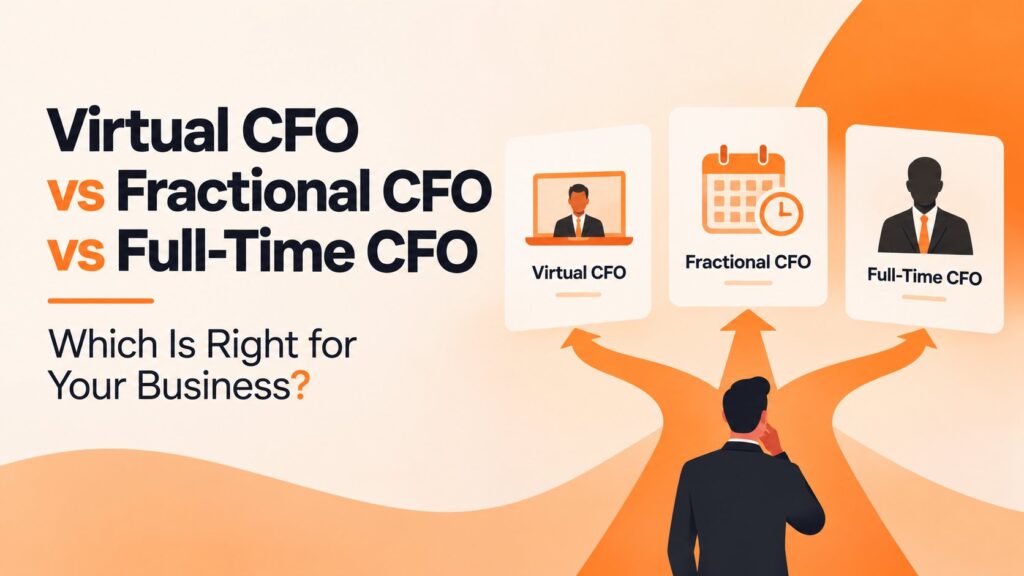
Virtual CFO vs Fractional CFO vs Full-Time CFO: Which Is Right for Your Business?
Growing businesses often know they need stronger financial leadership before they are ready to hire a traditional chief financial officer. That creates three common options: a virtual CFO, a fractional CFO, or a full-time CFO.
The labels are sometimes used loosely. The best choice depends less on the title and more on the decisions you need help with, the level of executive involvement required, and whether the supporting finance operation can produce reliable information.
What is a virtual CFO?
A virtual CFO delivers senior finance guidance primarily through a remote or hybrid model. The engagement may include management reporting, cash-flow planning, budgets, financial models, board or investor support, controls and finance-team oversight.
Virtual CFO services are often suitable for startups and small or mid-sized businesses that need recurring financial leadership but do not require an executive on-site every day. The provider may combine CFO oversight with analysts, controllers or accounting support.
What is a fractional CFO?
A fractional CFO works with a company for a defined portion of their time. The role is typically more embedded than a project consultant and may include leadership meetings, lender or investor discussions, team management and ownership of key finance initiatives.
The CFO might work a fixed number of days per month or allocate capacity around agreed outcomes. Some fractional CFOs work mostly on-site; others work remotely. “Fractional” describes the time commitment, while “virtual” describes the delivery model, so one person can be both.
What is a full-time CFO?
A full-time CFO is an employee responsible for financial strategy, governance, capital allocation, risk management and leadership of the finance function. The role is continuously available to the executive team and usually has authority across departments.
This model is most appropriate when the complexity, transaction activity, regulatory exposure, funding agenda or team size requires daily executive ownership.
Quick comparison
| Factor | Virtual CFO | Fractional CFO | Full-time CFO |
|---|---|---|---|
| Working model | Primarily remote or hybrid | Part-time allocation | Dedicated employee |
| Best fit | Recurring guidance with flexible delivery | Embedded leadership without a full-time hire | Continuous executive ownership |
| Capacity | Defined scope and cadence | Reserved days or hours | Full working capacity |
| Team support | Can be bundled with finance operations | Often leads an existing team | Builds and manages the internal function |
| Commitment | Usually flexible | Medium-term recurring | Long-term employment |
Choose based on the work to be done
Strategic planning and management reporting
If the immediate need is a budget, rolling forecast, KPI framework and regular management review, a virtual CFO may provide enough leadership—provided the underlying accounting data is accurate and timely.
Fundraising, transactions or a period of change
A fractional CFO can be effective when the CEO needs an experienced finance partner for investor discussions, due diligence, restructuring, rapid growth or a systems transition. The role can be expanded temporarily around critical milestones.
Daily cross-functional leadership
A full-time CFO becomes more valuable when finance decisions are constant, the organization has several business units or geographies, or the executive must continuously coordinate tax, treasury, compliance, risk and capital decisions.
Signals that you need CFO-level support
- Cash forecasts are unreliable or prepared only when cash becomes tight
- Management reports arrive late or do not explain business drivers
- The founder is making pricing, hiring or investment decisions without scenario analysis
- Investors or lenders are asking questions the team cannot answer quickly
- The business is preparing for fundraising, due diligence or a transaction
- Finance staff complete tasks but no one owns the overall operating model
- Growth has created control, compliance or working-capital problems
Do not overlook the finance operations layer
A CFO cannot lead effectively if reconciliations are incomplete, invoices are delayed and reports require manual reconstruction. Before choosing a model, assess the full finance stack: transaction processing, accounting close, compliance, management information and strategic leadership.
Some companies need a CFO. Others first need a controller, a dependable outsourced accounting team or better AP and AR workflows. A credible advisor should identify the right level rather than selling the most senior title.
Questions to ask before engaging a CFO
- Which decisions and outcomes will the CFO own?
- How much executive availability do the CEO and board require?
- Is the existing accounting information reliable enough for analysis?
- Will the CFO lead internal staff or bring an extended delivery team?
- Which meetings, reports and milestones are included?
- How will priorities be reviewed when the business changes?
- What knowledge and documentation will remain with the company?
A practical decision framework
Choose a virtual CFO when you need recurring senior guidance with flexible delivery. Choose a fractional CFO when you need an embedded executive for a portion of the week or month. Hire a full-time CFO when the organization needs continuous executive ownership and can support the role with a capable finance team.
Ocellus provides CFO services, finance-function outsourcing and operational support that can be shaped around the stage of the business. Explore our CFO services, learn about complete finance-function outsourcing, or discuss the right finance leadership model.