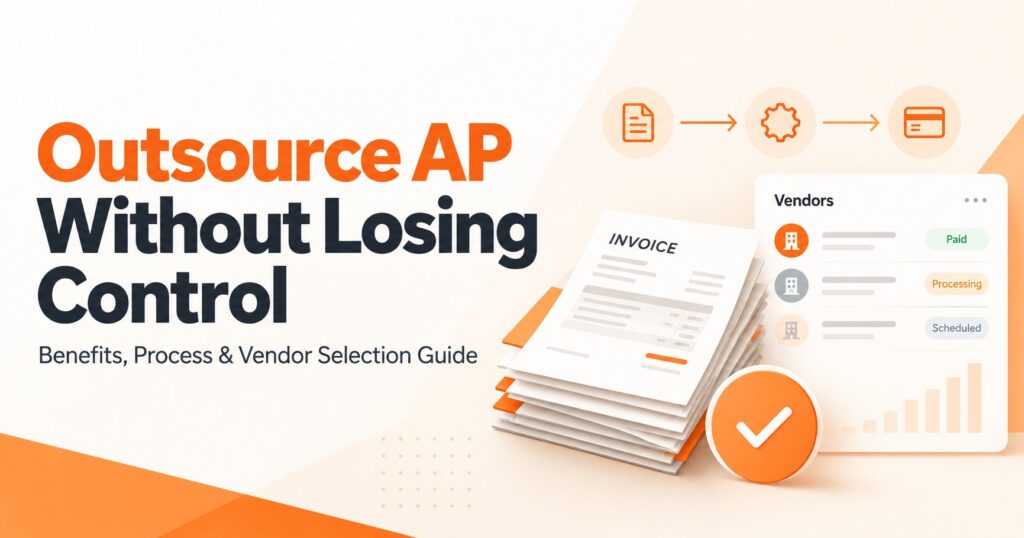
Accounts Payable Outsourcing: Benefits, Process and Vendor Selection Guide
Accounts payable outsourcing moves selected invoice-to-payment activities to a specialist operating team. It can give a growing business consistent processing capacity, clearer controls and better visibility without transferring payment authority away from management.
The decision is not simply whether an external team can enter invoices. The real question is whether the operating model can reduce exceptions, make responsibilities explicit and provide reliable information before each payment decision.
What is accounts payable outsourcing?
Accounts payable outsourcing is an arrangement in which an external provider performs agreed parts of the procure-to-pay process. The scope may begin with invoice capture and reconciliation or extend to vendor queries, approval tracking, payment-run preparation and management reporting.
Your business should continue to own policy, approval limits, bank access and final payment release. The provider operates the documented workflow and supplies the evidence your authorized team needs to review and approve transactions.
Which AP activities can be outsourced?
- Vendor master-data maintenance under an approved process
- Invoice receipt, validation, coding and duplicate checks
- Purchase-order and receipt matching where applicable
- Approval routing, reminders and escalation tracking
- Payment-run schedules for client review and authorization
- Vendor statement and general-ledger reconciliation
- Ageing, exception and turnaround-time reporting
- Vendor query coordination and document follow-up
A well-designed scope distinguishes routine processing from judgement and authorization. Exceptions involving commercial disputes, policy changes or payment approval should remain with the appropriate internal owner.
When does outsourcing make sense?
AP outsourcing is often considered when invoice volumes are growing faster than the finance team, month-end close is repeatedly delayed, vendor statements do not reconcile, or senior finance staff spend too much time chasing documents and approvals.
It may also help businesses with seasonal volume swings, operations across several entities, fragmented invoice channels or limited process documentation. Outsourcing will not fix an undefined policy by itself, so the transition should first clarify the approval matrix, supporting documents, ownership and escalation rules.
Potential benefits
More consistent processing capacity
A dedicated operating team can absorb recurring transactional work and reduce dependence on one internal employee. This is particularly useful as transaction volume changes.
Stronger process visibility
Ageing reports, pending-approval trackers, reconciliation status and exception logs allow finance leaders to see where work is waiting and why.
Clearer controls
Documented responsibilities, segregation of duties and evidence requirements make the workflow easier to review and audit.
More time for internal finance
Controllers and finance managers can focus on cash planning, commercial decisions and analysis instead of routine follow-up.
Risks to manage
The main risks are unclear ownership, inappropriate system access, weak knowledge transfer and a scope that ignores exceptions. Manage these through role-based access, documented SOPs, named approvers, service reviews and a formal escalation path. Do not allow the outsourced team to both prepare and authorize payments.
How to evaluate an AP outsourcing provider
- Process depth: Can the provider explain matching, reconciliations, approval routing and exception handling?
- Transition approach: Will it document the current process and complete a controlled knowledge transfer?
- Controls: Are access, segregation of duties and payment authorization clearly defined?
- Reporting: Which ageing, exception, reconciliation and status reports are included?
- Technology fit: Can the team operate within your accounting or ERP environment?
- Security: Are information-security and data-handling practices independently supported?
- Commercial clarity: Is pricing linked to a defined scope, capacity or transaction band?
A practical transition plan
Start with discovery and volume analysis. Map the current workflow, collect sample documents, identify recurring exceptions and confirm the approval matrix. The provider should then prepare SOPs and a responsibility matrix before access is granted.
Knowledge transfer should include normal transactions as well as difficult cases. A parallel run may be appropriate for higher-risk processes. Once steady-state delivery begins, review ageing, exceptions, reconciliations and service issues on an agreed cadence.
Questions to answer before signing
- Which activities are in scope and explicitly out of scope?
- Who owns vendor disputes and policy exceptions?
- Who approves and releases payments?
- What evidence is required for every transaction?
- Which systems and folders will the provider access?
- How will urgent requests and escalations be handled?
- What happens if transaction volume changes?
AP outsourcing should improve control—not remove it
The strongest model combines specialist processing capacity with clear internal authority. Ocellus supports accounts payable and receivable operations through documented workflows, reconciliations, exception reporting and client-controlled approvals. Explore our accounts payable and receivable outsourcing services or discuss your current AP process.